Beyond Dashboards: Building the "Self-Healing" Supply Chain with Agent Swarms
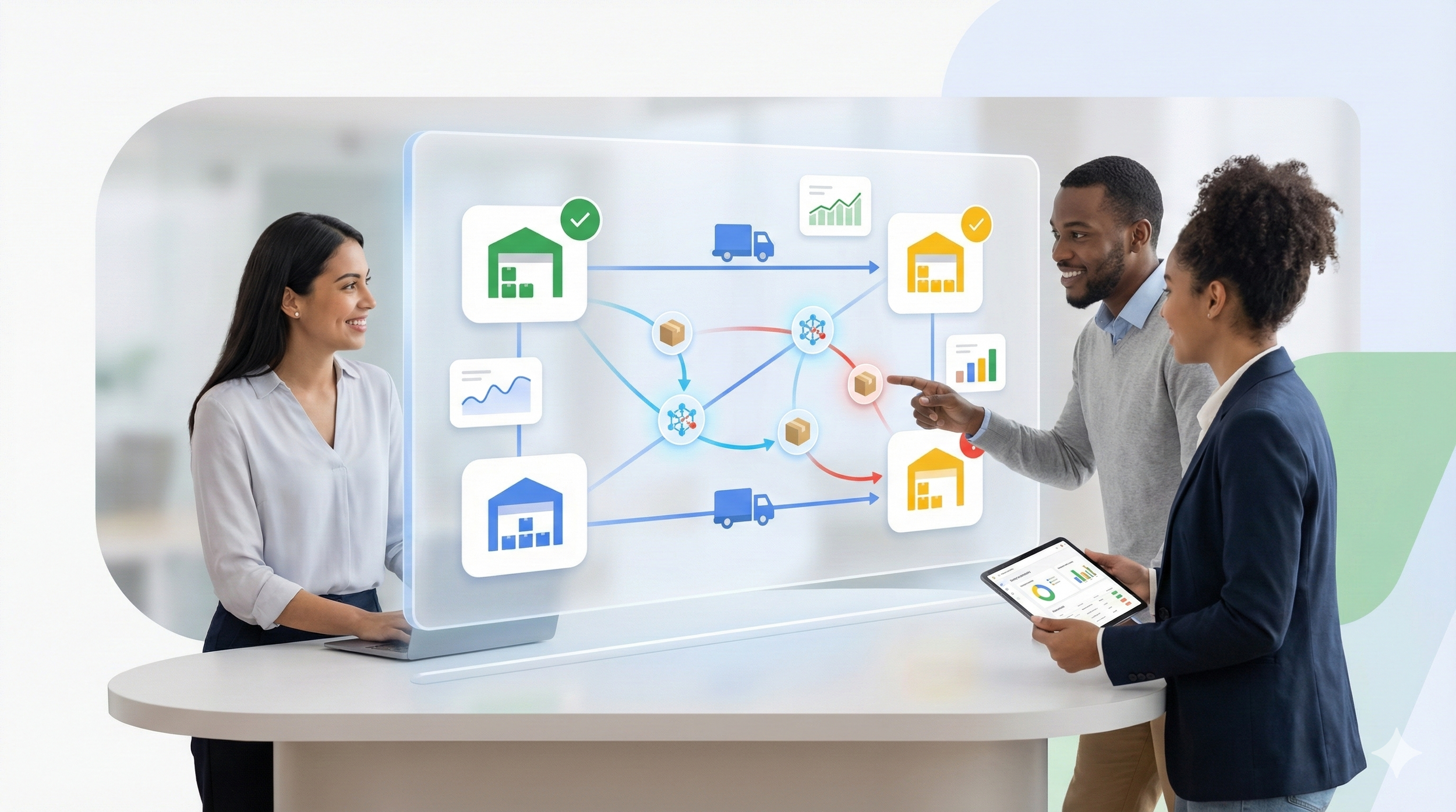
In modern retail, the "Static Demand Plan" is a myth.
You spend months planning inventory for Q4, and then reality hits. A sudden cold front in Florida spikes demand for heaters. A viral TikTok trend clears out a specific shade of lipstick in 48 hours. A port strike delays a shipment by three weeks.
Traditional supply chain tools even the "modern" ones, are fundamentally reactive. They are excellent at generating red alerts on a dashboard:
“Alert: Stockout imminent in Distribution Center B.”
“Alert: Demand spike in Region 4.”
But who fixes it? Humans.
Your planners have to frantically scramble, manually re-allocating stock, calling trucking companies, and updating the ERP. By the time they react, the sales are already lost.
At Evonence, we are moving retail leaders from Visibility to Autonomy with the Autonomous Inventory Rebalancing System.
The Solution: The Supply Chain That Heals Itself
We don't just build a better dashboard; we deploy a Multi-Agent Swarm.
Imagine a team of specialized AI agents that never sleep, constantly negotiating with each other to optimize your inventory in real-time. Instead of a linear chain of command, it is a mesh of intelligence.
The Demand Agent: Watches hyper-local signals (weather, social trends, local events) and predicts a spike in heaters in Miami before it happens.
The Inventory Agent: Sees that the Miami warehouse is low, but the Atlanta warehouse is overstocked.
The Logistics Agent: Instantly calculates the cost and time to truck goods from Atlanta to Miami versus ordering new stock.
Instead of sending an alert to a human, these agents communicate via an Agent-to-Agent (A2A) Protocol. They negotiate the best outcome, agree on the transfer, and the Logistics Agent writes the transfer order directly into your ERP.
The stock moves physically. The problem is solved. No human intervention required.
Under the Hood: Google Cloud’s High-Velocity Stack
This level of autonomy requires immense speed and data scale. This is where the Google Cloud stack separates itself from the pack.
1. Gemini 3 Flash
To monitor thousands of SKUs across hundreds of locations, you need a model that is fast and cost-effective. We use Gemini 3 Flash to process high-volume demand signals in real-time. It doesn't just look at "sales history"; it reads unstructured data—news reports about storms, social media sentiment—to predict demand shifts that spreadsheets miss.
2. BigQuery (The Real-Time Truth)
The agents need a single source of truth. BigQuery acts as the live nervous system, ingesting inventory positions from your WMS (Warehouse Management System) and POS (Point of Sale) instantly. The agents query BigQuery to know exactly where every unit is, down to the second.
The Migration Advantage: Action vs. Visibility
Many retailers are currently evaluating or using AWS Supply Chain. It is a capable tool, but there is a critical philosophical difference.
AWS Supply Chain is primarily a "Visibility" platform. It is fantastic at aggregating data and showing you a map of your problems.
Evonence on Google Cloud is an "Action" platform.
We don't just show you the map; our agents drive the car. While a competitor's tool might flag a "Low Stock Risk," our agents have already initiated the stock transfer request to mitigate it. We are moving you from "Admiring the Problem" to "Solving the Problem."
| Feature | Traditional / Competitor Tools | Evonence Autonomous System |
|---|---|---|
| Primary Goal | Visualize Data | Execute Actions |
| Response Time | Hours/Days (Human dependent) | Seconds/Minutes (Agent dependent) |
| Data Inputs | Historical Sales | Real-time Weather, Social, News, Sales |
| Output | Dashboard Alert | ERP Transfer Order |
The Evonence Vision: A Strategic Transformation
This isn't a simple plugin; it is a fundamental reimagining of logistics operations. While a full "Self-Healing Supply Chain" is a strategic journey, the value is transformative.
Phase 1 (Months 1-6): "Shadow Mode." Agents run in the background, predicting transfers and asking humans for approval to verify accuracy.
Phase 2 (Months 6-12): "Hybrid Autonomy." Autonomous execution is turned on for low-risk, high-velocity SKUs (e.g., paper towels, staples), freeing humans to focus on complex issues.
Phase 3 (Months 12+): "Full Autonomy." Agents handle complex, seasonal, and trend-driven inventory, creating a supply chain that reacts faster than the weather.
Stop managing your inventory with rear-view mirrors.
Contact Evonence today to define your Autonomous Supply Chain roadmap.