Beyond the Barcode: Revolutionizing Retail Analytics with Google BigQuery
The modern retail landscape has undergone a seismic shift. No longer driven solely by intuition, legacy merchandising strategies, or gut-feeling inventory management, today’s retail success is dictated by the ability to process and act upon microscopic digital signals. Every time a consumer scans a loyalty card, clicks a product image on a mobile application, abandons a digital cart, or leaves a review, they generate a critical piece of data. Together, these millions of micro-interactions form the "invisible patterns" of retail success.
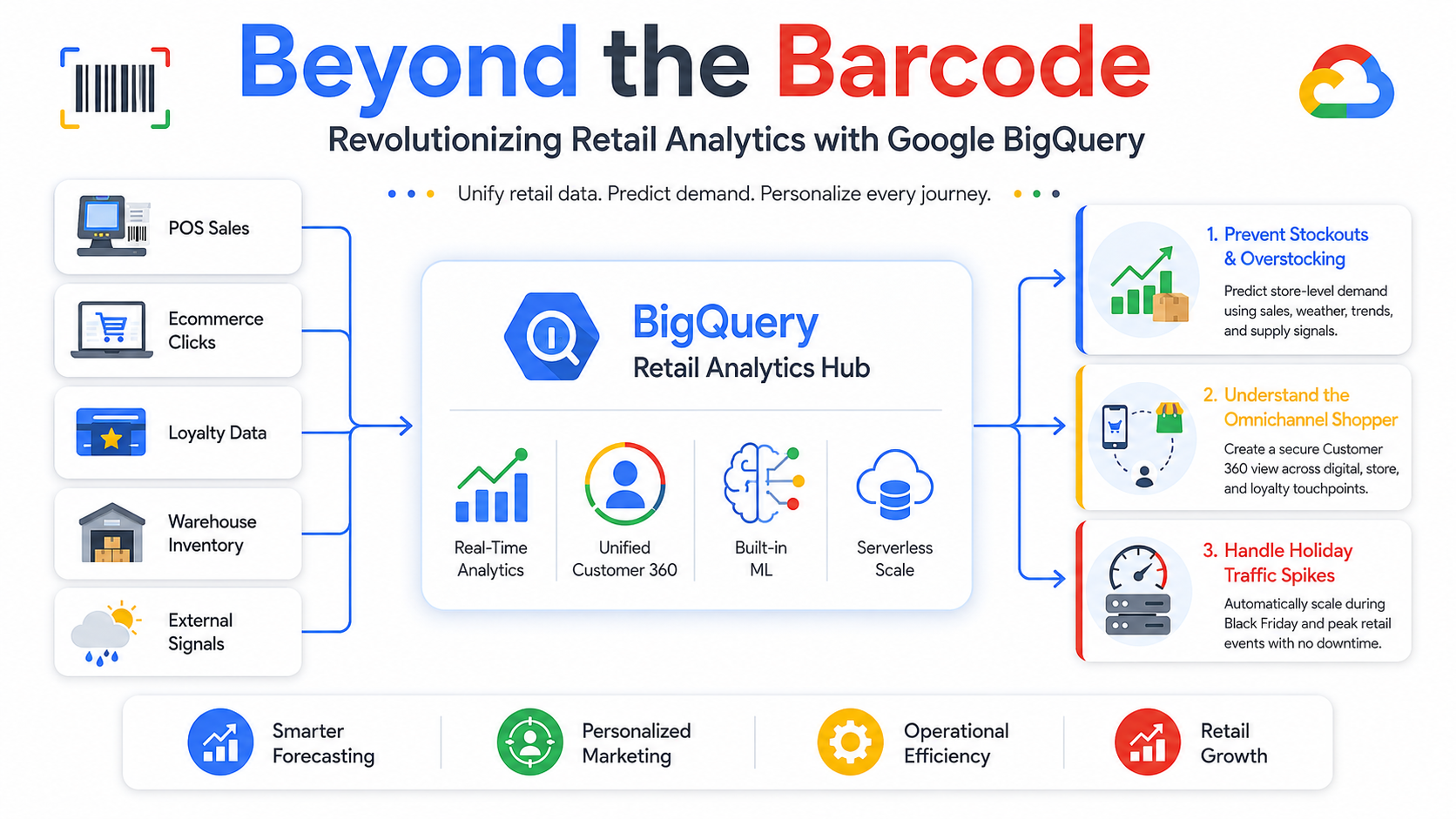
However, for most enterprise retail organizations, this invaluable data remains trapped. It is fragmented across dozens of disconnected, legacy systems—from point-of-sale (POS) terminals and warehouse management software (WMS) to third-party logistics (3PL) databases and siloed e-commerce platforms. This fragmentation creates a profound blind spot for Chief Information Officers (CIOs) and retail strategists, leading to lost revenue, inefficient supply chains, and disjointed customer experiences.
To thrive in an era where consumer loyalty is fleeting and margins are razor-thin, retailers must transition from looking at historical, fragmented reports to predicting future outcomes through unified, real-time analytics. Google BigQuery serves as the foundational enterprise data warehouse for this exact transformation.
As a premier Google Cloud professional services provider, we specialize in helping global retail businesses implement BigQuery to answer their most complex operational and strategic questions. In this comprehensive guide, we explore the deep architectural advantages of Google Cloud and how a unified data strategy provides definitive answers to the most pressing questions facing retail leadership today.
The Architectural Crisis in Modern Retail Data
Before diagnosing specific business challenges, it is crucial to understand why traditional data infrastructure fails modern retailers. Legacy on-premises databases and early-generation cloud data warehouses were built for an era of batch processing. They rely on rigid ETL (Extract, Transform, Load) pipelines that run overnight. By the time a store manager or supply chain director sees a report on Tuesday morning, the data is already 24 hours old.
Furthermore, traditional systems tightly couple compute and storage. If you need more storage for years of historical sales data, you are forced to buy more compute power, even if you do not need it, leading to exorbitant IT costs.
The Google BigQuery Advantage
Google BigQuery disrupts this legacy model through a serverless, highly scalable, and cost-effective multi-cloud data warehouse designed for business agility. Its architecture entirely decouples compute from storage, allowing retailers to store petabytes of data for pennies on the dollar while instantly summoning massive computational power only when a query is executed.
With built-in machine learning (BigQuery ML), real-time streaming ingestion, and seamless integration with the broader Google Cloud ecosystem (such as Pub/Sub for messaging and Dataflow for stream processing), BigQuery transforms passive data into proactive intelligence. Let us examine how this architecture solves three critical diagnostic questions for retail enterprises.
Diagnostic Question One: How Do We Prevent Costly Stockouts and Overstocking?
The Challenge: The Bullwhip Effect and Capital Inefficiency
Retailers constantly battle the "bullwhip effect" within their supply chains. A slight shift in consumer demand at the retail level causes progressively larger fluctuations in demand at the wholesale, distributor, manufacturer, and raw material supplier levels.
Ordering too much inventory locks up vital working capital, increases warehousing costs, and inevitably leads to massive discount markdowns at the end of a season. Conversely, ordering too little results in stockouts, empty shelves, frustrated shoppers, and irrecoverable lost revenue. Traditional demand forecasting relies on historical spreadsheets and rolling averages that simply cannot account for sudden shifts in consumer behavior, viral social media trends, or unexpected supply chain bottlenecks.
The BigQuery Resolution: Real-Time Predictive Analytics and BigQuery ML
Google BigQuery fundamentally changes how enterprise inventory is managed by shifting the paradigm from reactive historical reporting to proactive, real-time predictive analytics.
Because BigQuery can process petabytes of data in seconds, our data engineering teams can build data pipelines that integrate your internal enterprise resource planning (ERP) and POS data with vast external datasets. Through Google Cloud's Analytics Hub and public datasets, retailers can seamlessly blend their sales history with:
Hyper-local weather forecasts: Predicting spikes in demand for umbrellas, cold-weather gear, or seasonal hardware.
Macro-economic indicators: Adjusting luxury goods forecasts based on consumer confidence indexes.
Global supply chain data: Factoring in shipping port congestion or global logistics delays.
Democratizing Data Science with BigQuery ML (BQML)
The true differentiator is BigQuery ML. BQML empowers data analysts to create, train, and execute machine learning models using standard SQL queries directly inside the data warehouse. There is no need to export massive datasets to a separate machine learning environment, which reduces latency and security risks.
Using advanced time-series forecasting models (like ARIMA_PLUS) built directly into BigQuery, the system analyzes massive, multi-variable datasets to predict exact inventory needs down to the individual SKU and specific store level. Your purchasing managers receive proactive, automated alerts to restock specific winter apparel in a targeted geographic region just days before a sudden blizzard hits. This precision maximizes gross margin return on investment (GMROI) while keeping warehouse holding costs incredibly low.
Diagnostic Question Two: How Can We Truly Understand the Omnichannel Shopper?
The Challenge: Identity Fragmentation in a Cookieless World
The modern purchasing journey is non-linear. A customer might discover a product via an influencer on a social media network on their smartphone, research the technical specifications on their work laptop via your corporate website, and ultimately purchase the item at a physical brick-and-mortar location using a different credit card.
If your marketing, digital commerce, and physical retail departments operate in isolated databases, you will never see the complete journey of that shopper. This fragmentation leads to a disjointed customer experience, redundant marketing spend, and ineffective advertising campaigns that annoy consumers rather than convert them. Furthermore, with the deprecation of third-party cookies, relying on external ad networks for customer insights is no longer a viable long-term strategy.
The BigQuery Resolution: Identity Resolution and the Customer 360 View
First-party data is the new currency of retail. Our professional services consultants specialize in dismantling enterprise data silos to build a powerful, proprietary Customer Data Platform (CDP) natively on Google Cloud. We utilize BigQuery to create a single, unified "Customer 360-degree view."
By utilizing tools like Google Cloud Data Fusion and Datastream, we securely funnel all data streams—CRM records, loyalty program data, email engagement metrics, mobile app events (via Firebase), and in-store POS transactions—into one centralized, secure BigQuery repository.
Once the data is centralized, we apply sophisticated identity resolution algorithms. BigQuery processes deterministic data (like email addresses and phone numbers) and probabilistic data (like IP addresses and browsing behaviors) to stitch together a single, unified customer profile.
Hyper-Personalization at Scale
With a unified profile, your marketing teams can map the entire consumer lifecycle. You can identify exactly which digital marketing campaigns are driving the most physical store visits (Online-to-Offline attribution).
Furthermore, you can use these insights to power hyper-personalized marketing engines. If BigQuery data indicates a customer consistently purchases professional running shoes every eight months, and frequently browses moisture-wicking apparel, the system can automatically trigger a customized, multi-channel promotional offer precisely when they are entering their buying window. This level of personalization dramatically increases customer lifetime value (CLV) and brand loyalty.
Diagnostic Question Three: How Do We Manage Extreme Traffic Spikes During Peak Sales Events?
The Challenge: The Infrastructure Breaking Point
Black Friday, Cyber Monday, Singles' Day, and localized promotional events represent the most critical revenue days of the retail calendar. They are also the exact moments when legacy database systems and under-provisioned cloud environments are most likely to suffer catastrophic failure.
An unprecedented surge in concurrent user traffic, dynamic pricing updates, and complex inventory lookups can cause legacy relational databases to lock up. A database crash during a peak holiday sale does not just result in millions of dollars in immediately lost revenue; it severely damages brand reputation and drives loyal customers directly to competitors.
The BigQuery Resolution: Serverless Auto-Scaling and Streaming Ingestion
BigQuery was engineered by Google to handle the exact same scale of data that powers Google Search and YouTube. It operates on a fully managed, serverless architecture. This means there is no underlying infrastructure for your Information Technology department to provision, patch, scale, or maintain.
Handling the Holiday Surge seamlessly
When traffic spikes by several thousand percent during a flash sale, BigQuery automatically and instantaneously scales its computing resources in the background to handle the query load seamlessly. Utilizing the BigQuery Streaming API, data from web clicks, cart additions, and processed transactions is ingested in real-time, making it available for analysis within milliseconds.
This allows your e-commerce and executive teams to monitor live dashboards—powered by Looker, Google Cloud’s enterprise platform for business intelligence—tracking inventory depletion rates, geographic sales heatmaps, and dynamic pricing elasticity in real time. You capture every single data point without experiencing a moment of database downtime, and thanks to BigQuery's flexible pricing models, you only pay for the exact computing power you consume during that peak window.
Beyond the Basics: The Future of Retail with Generative AI
Consolidating data in BigQuery is not just about solving today’s problems; it is about future-proofing your business for the next era of retail technology: Generative Artificial Intelligence.
By housing your enterprise data in BigQuery, you seamlessly unlock the capabilities of Google Cloud’s Vertex AI and Gemini models. Because your product catalogs, customer reviews, and sales history are already formatted and stored in BigQuery, you can leverage Vertex AI to build Retrieval-Augmented Generation (RAG) applications.
Imagine a highly intelligent conversational commerce agent on your mobile app that doesn't just give generic answers, but understands a customer’s specific purchase history, checks real-time inventory via BigQuery, and uses Generative AI to say: "I see you're looking for a tent for your upcoming trip to Colorado. Based on the forecasted weather there next week, and the fact that you prefer ultra-light gear, I recommend the Alpine Pro-3. We have two in stock at your local downtown store." This is not science fiction; this is the reality of what is currently being built by forward-thinking retailers utilizing the synergistic power of BigQuery and Vertex AI.
Security, Governance, and Enterprise Compliance
In the retail sector, data security is paramount. Handling Personally Identifiable Information (PII) and Payment Card Industry (PCI) data requires stringent governance. BigQuery provides enterprise-grade security by default. Data is encrypted both at rest and in transit.
Through Google Cloud’s robust Identity and Access Management (IAM) and BigQuery’s column-level and row-level security, retail organizations can enforce granular access controls. A regional store manager can be granted access to query sales data strictly for their specific location, while data scientists can access generalized, anonymized datasets across the entire organization. Features like Cloud Data Loss Prevention (DLP) natively integrate with BigQuery to automatically discover, classify, and redact sensitive PII before it is ever exposed to analysts, ensuring total compliance with GDPR, CCPA, and global privacy frameworks.
Partnering for Retail Dominance: Your Migration Journey
Transforming a traditional retail operation into a highly agile, predictive, data-driven enterprise requires more than just purchasing software; it requires deep technical expertise, strategic change management, and flawless execution.
As a certified Google Cloud Premier Partner, our professional services team acts as your dedicated guide. We do not just hand you a platform; we architect the solution. Our data engineers handle the complexities of legacy database migration, automated data pipeline construction, and rigorous data quality testing. We ensure your migration to Google BigQuery is secure, compliant with all industry regulations, and optimized for maximum Return on Investment from day one.
Stop guessing what your customers want, and start knowing. The invisible patterns of your future success are already hidden within your data. It is time to illuminate them.
Contact our retail data architecture specialists today to schedule a comprehensive, no-obligation audit of your current data infrastructure, and discover how Google BigQuery can transform your retail enterprise.