Scaling from Seed to Success: A Founder’s Playbook for Data Dominance with Google BigQuery
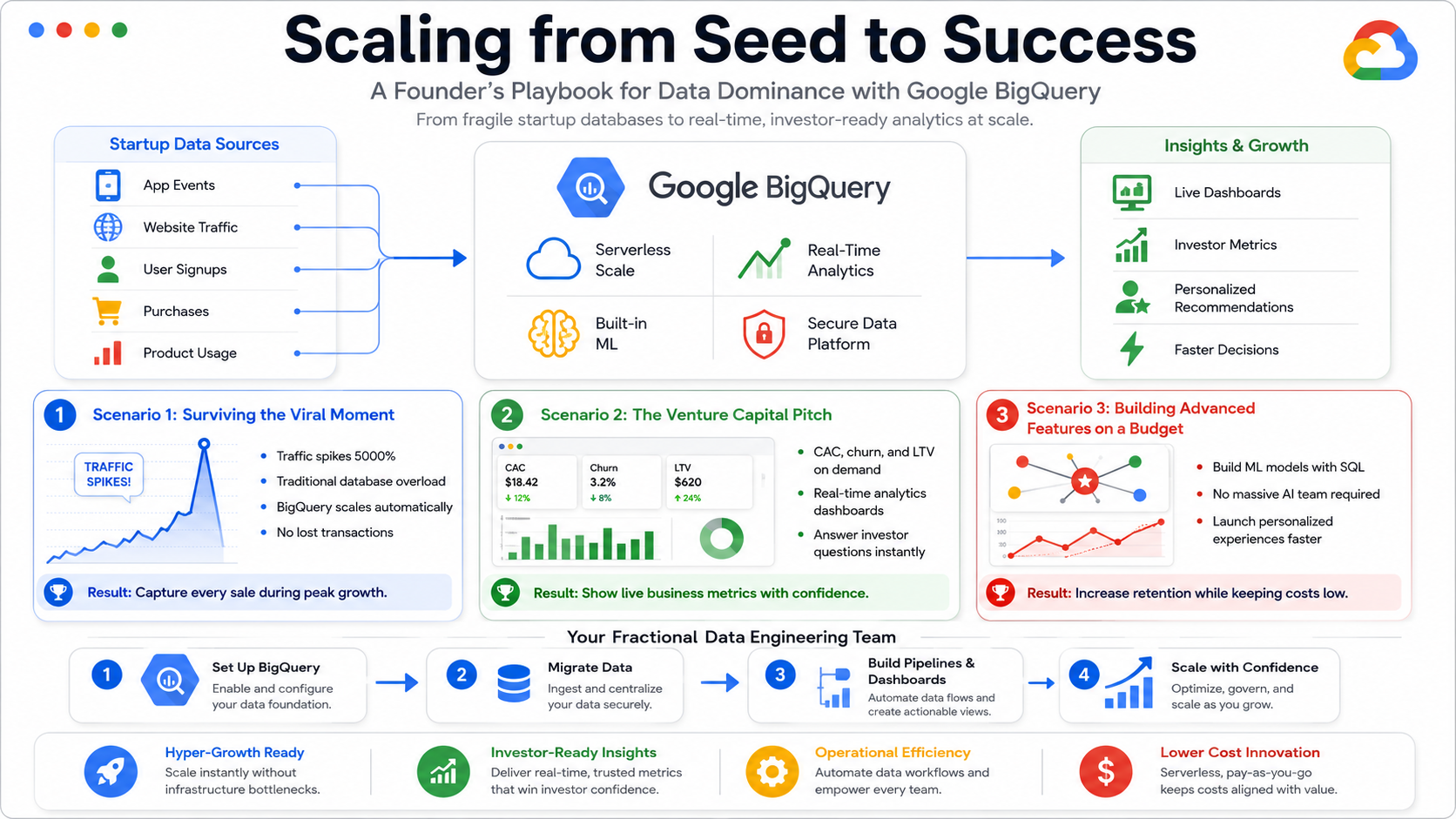
Every startup founder dreams of the "hockey stick" growth curve. You launch your product, a high-profile influencer shares it, or a major publication picks up your story, and suddenly, thousands of new users are flooding your application. It is the ultimate goal, but it is also the exact moment when fragile, early-stage technology infrastructure shatters.
In the early days of building a company, founders often rely on basic, open-source transactional databases (like PostgreSQL or MySQL) to save money and move quickly. However, as the user base grows and data accumulates exponentially, these databases begin to slow down, crash under analytical pressure, and make it impossible to extract meaningful insights.
When you are preparing to pitch to Venture Capital (VC) firms for your next round of funding, you cannot afford to have your Key Performance Indicators (KPIs) locked inside a frozen, overloaded database. Data maturity is no longer just an enterprise luxury; it is a fundamental requirement for startup survival and valuation.
Google BigQuery is the ultimate equalizer for startups. It allows a five-person seed-stage team to access the exact same planetary-scale data analytics power as the largest technology conglomerates in the world. As a dedicated professional services partner for emerging companies, we implement BigQuery to help founders transform raw data from a liability into their ultimate competitive advantage.
The Architectural Shift: Why Traditional Databases Fail at Scale
To understand why startups hit a data wall, we must look at how traditional databases are built. Most early-stage applications use Online Transaction Processing (OLTP) databases. These systems are optimized for rapid, single-row operations like updating a user's password or recording a single purchase.
However, when you ask an OLTP database to perform Online Analytical Processing (OLAP) such as calculating the average lifetime value of all users over the past three years it must scan millions of rows simultaneously. This starves the database of computing resources, causing your live application to slow to a crawl or crash entirely.
Google BigQuery solves this fundamental bottleneck through a completely different architectural paradigm: the separation of storage and compute. BigQuery stores data in Colossus (Google's global storage system) and processes queries using Dremel (a highly scalable compute engine). Because these two layers are decoupled, you can store petabytes of data for pennies, and only pay for the massive compute power during the exact milliseconds a query is running.
Here is how a modern data warehouse compares to traditional early-stage setups:
| Feature | Traditional Relational Database | Google BigQuery |
|---|---|---|
| Primary Use Case | Transactional app operations (OLTP) | Large-scale analytics & AI (OLAP) |
| Infrastructure | Server-based (requires provisioning) | Fully serverless (zero provisioning) |
| Scaling | Manual scaling, prone to downtime | Instant, automatic scaling |
| Concurrency | Low for heavy analytical queries | Extremely high concurrent queries |
| Maintenance | High (vacuuming, indexing, patching) | Fully managed (No-Ops) |
The Playbook: Overcoming Growing Pains with BigQuery
Transitioning to a modern data stack empowers founders to navigate the most critical phases of startup growth. Let's explore three make-or-break scenarios where BigQuery transforms operational chaos into strategic dominance.
Scenario One: Surviving the Viral Moment
The Challenge: Your marketing campaign goes viral. Your website traffic spikes by 5000% in one hour. Your traditional database hits its maximum compute capacity trying to ingest telemetry data, user events, and complex query requests simultaneously, causing your checkout pages to time out. You are losing thousands of dollars in revenue every minute, and frustrating your newest users.
The BigQuery Play: Because BigQuery operates on a fully serverless, highly distributed architecture, there are no physical limits or virtual machines for your engineering team to manage. The system automatically detects the massive influx of data and scales its computing power instantly in the background. Using streaming inserts or Google Cloud Pub/Sub integrations, BigQuery can ingest millions of rows per second without breaking a sweat.
The Result: Your core application database is relieved of analytical burdens, meaning your website remains lightning-fast. Every new user registration, click, event, and purchase is securely recorded into your data warehouse without a single dropped transaction. You capture the full financial and operational benefit of your viral moment, turning a potential disaster into a massive growth milestone.
Scenario Two: The Venture Capital Pitch
The Challenge: You are sitting in a boardroom with leading Tier-1 investors. They are interested in your product, but they want to know the hard numbers: your exact Customer Acquisition Cost (CAC), your monthly net revenue retention (NRR), and the lifetime value (LTV) of your users segmented by geographic region and cohort. Your current data tools require a senior engineer to spend three days manually exporting spreadsheets, cleaning data in Python, and building fragile pivot tables.
The BigQuery Play: BigQuery enables real-time analytics across massive, disparate datasets. By leveraging BigQuery's seamless integration with Business Intelligence (BI) tools like Looker, our professional services team builds automated, single-source-of-truth dashboards directly connected to your data warehouse. Using standard SQL, your data analysts can slice and analyze terabytes of historical data in milliseconds.
The Result: You open your presentation and show the investors a live, real-time dashboard of your business metrics. When a partner asks a complex financial question ("How did cohort retention change in Europe after the Q2 pricing update?"), you answer it instantly by filtering the live dashboard. You prove to the board that your leadership team makes rigorous, data-driven decisions, drastically increasing your chances of securing a favorable term sheet.
Scenario Three: Building Advanced AI Features on a Bootstrapped Budget
The Challenge: You want to add an intelligent recommendation engine, fraud detection system, or predictive churn model to your product using Machine Learning (ML). However, you cannot afford to hire a massive team of specialized data scientists, nor do you have the budget for expensive, standalone MLOps platforms.
The BigQuery Play: BigQuery democratizes artificial intelligence by embedding Machine Learning capabilities directly into the database (BigQuery ML). Your existing software developers and data analysts can use standard SQL query languages to build, train, and deploy predictive models right where the data already lives. There is no need to export data, manage complex Python environments, or worry about data pipelines breaking. Furthermore, with the integration of Vertex AI and Google's Generative AI foundational models (like Gemini), you can easily run natural language processing, sentiment analysis, and LLM-driven insights directly on your BigQuery tables.
The Result: You launch a highly personalized, AI-driven user experience months ahead of your better-funded competitors. You significantly increase user engagement and retention, all while keeping your operational costs remarkably low and leveraging your existing team's SQL skill sets.
Strategic Cost Optimization: Scaling Without Breaking the Bank
A common misconception among founders is that enterprise-grade cloud tools come with enterprise-grade price tags. In reality, BigQuery’s flexible pricing model is highly favorable for startups—if configured correctly.
Our data engineering experts ensure your BigQuery environment is optimized for cost-efficiency from day one:
Partitioning and Clustering: We structure your tables so that queries only scan the exact data they need (e.g., partitioning by date), dropping your query costs by up to 90%.
Flexible Pricing Models: Startups can leverage the On-Demand pricing model (paying only for the bytes processed) during the early days, and smoothly transition to Capacity pricing (predictable monthly flat rates) as analytical workloads mature.
Cost Controls and Quotas: We implement strict custom quotas and billing alerts so an accidental runaway query never results in billing shock at the end of the month.
Security, Governance, and Preparing for Series B
As you scale from Seed to Series A and beyond, compliance becomes a major hurdle. Enterprise clients will demand SOC2, ISO 27001, HIPAA, or GDPR compliance before they sign a contract with you.
BigQuery provides enterprise-grade security out of the box. All data is encrypted at rest and in transit by default. Through Google Cloud’s Identity and Access Management (IAM), we can implement row-level and column-level security. This means a marketing manager can query the same table as the HR director, but the database will automatically hide Personally Identifiable Information (PII) from the marketer. Building this level of governance into your foundation early prevents painful, expensive security audits later on.
Your Fractional Data Engineering Team
Startups need to move fast. As a founder, you should be hyper-focused on achieving product-market fit, leading your team, and closing deals—not configuring server clusters, writing ETL pipelines, or debugging database indexes.
Our professional services group acts as your dedicated, fractional data engineering team. We provide the expertise of seasoned data architects without the overhead of full-time enterprise salaries. Our implementation framework is designed for speed and reliability:
Architecture Design: We map out a scalable data model tailored to your specific SaaS, E-commerce, or FinTech product.
Zero-Downtime Migration: We seamlessly replicate data from your production databases (PostgreSQL, MySQL, MongoDB) into BigQuery using robust tools like Fivetran, Datastream, or dbt.
Pipeline Construction: We build automated, self-healing analytical pipelines that transform raw data into business-ready metrics.
Dashboard Deployment: We connect your new data warehouse to industry-leading BI tools, handing you the keys to a fully operational insights engine.
Stop Letting Infrastructure Limit Your Growth Potential
Do not wait until your database crashes during your biggest marketing launch, or until you are scrambling to manually compile numbers for a critical board meeting. The foundation you build today dictates the scale you can achieve tomorrow.
Connect with our startup acceleration experts today to see how quickly we can implement Google BigQuery, future-proof your data stack, and get you ready for your next phase of hyper-growth.