The Triage Agent That "Thinks" Before It Speaks: Reducing Nurse Burnout with Safer AI
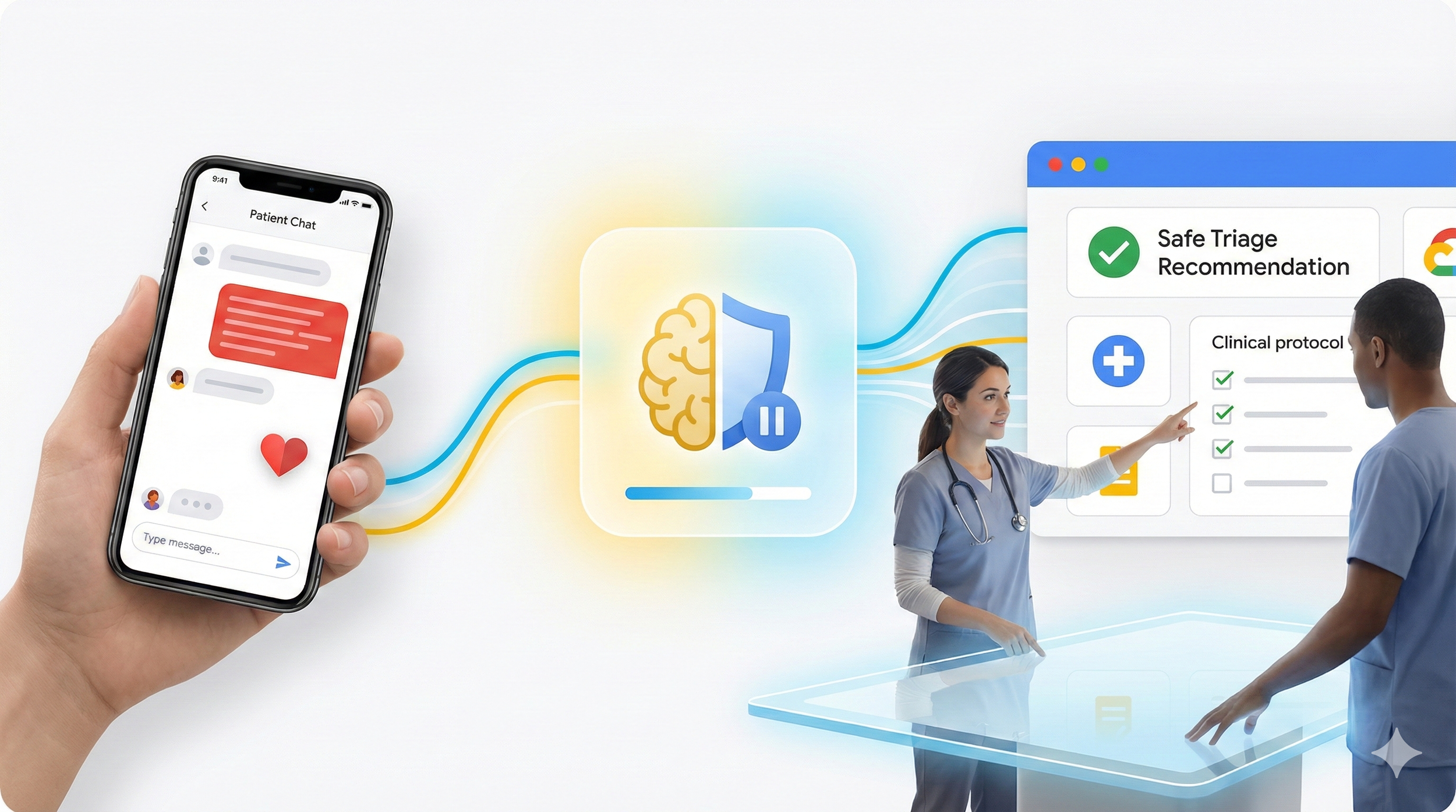
Triage agent
The Problem: The "Digital Front Door" is Jammed
The "Digital Front Door" of many health systems is broken. Patients attempting to schedule appointments or report symptoms via chat are often met with rigid decision trees ("Press 1 for Pharmacy") or basic LLMs that scan for keywords without understanding context.
A patient saying "My chest feels heavy when I breathe" might be routed to Respiratory Scheduling by a standard bot looking for the keyword "breathe." However, a human nurse recognizes the subtle qualifiers—"heavy," "chest"—that indicate a potential cardiac event requiring the ER.
To prevent these errors, hospitals rely on highly skilled nurses to manually triage every incoming interaction. The result is a crisis in workforce sustainability:
Nurse Burnout: Clinical staff spend nearly 30% of their shift on administrative data gathering—asking repetitive questions about medications and history—instead of practicing top-of-license care.
Patient Frustration: Long wait times on hold just to answer basic questions.
At Evonence, we are deploying a safer alternative: The Reasoning Triage Agent.
The Solution: An Agent with a "Safety Pause"
We don’t build chatbots that just "reply." We build agents that "think."
Using the latest advancements in Google’s Gemini 3.0 models, we deploy agents capable of Chain-of-Thought reasoning. Unlike previous generations of AI that rushed to predict the next word, our agents perform a hidden "safety check" loop.
Clinical Example: The "Thinking" Difference
"I have a sharp pain in my lower right side and I feel nauseous."
Result: Match found for General Medicine.
The agent doesn't just match keywords; it formulates a differential triage strategy dynamically, grounded in clinical protocols.
Architecture Diagram: The "Reasoning Budget" Workflow
The following diagram illustrates how the "Safety Pause" works technically. The agent allocates a compute budget to "think" before generating any text for the patient.
The "Reasoning Budget" Workflow
Under the Hood: Why Gemini 3.0 "Thinking Budgets" Change the Game
Why is this different from the AI hype of last year? It comes down to Reasoning Budgets.
In standard Gen AI, the model is optimized for speed, rushing to predict the next token. In Gemini 3.0 Pro, we can allocate a "compute budget" for reasoning. We force the model to spend extra milliseconds evaluating its own logic against safety guidelines before it generates a single character of output.
1. Grounded by Vertex AI Search for Healthcare
We ground the agent using Vertex AI Search for Healthcare. This ensures the agent:
Understands medical semantics (e.g., mapping "myocardial infarction" to "heart attack").
Pulls answers strictly from your hospital’s approved clinical guidelines and unstructured data (PDFs, protocols), never from the open internet.
2. The "Safety Wrapper" & Warm Handoffs
We wrap the agent in a governance layer. If the "Reasoning Budget" calculates a high probability of an emergency, the agent triggers a Warm Handoff.
The Tech: The session is paused, and a transcript is securely sent to a triage nurse.
The Experience: The nurse enters the chat knowing the full context. The patient never has to repeat themselves.
The Migration Advantage: Safety Over Speed
Many providers experimented with basic LLMs and stopped due to "hallucinations" (AI making up facts).
The shift to Reasoning Models is the safety breakthrough healthcare has been waiting for. Unlike standard bots that confidently guess, a Reasoning Agent is architected to "doubt and verify." It is slower by design—milliseconds matter less than accuracy in triage—making it the only viable path for clinical use cases.
The Evonence Approach: A 10-Week Clinical Pilot
Healthcare demands caution. We don't "move fast and break things." We move deliberately.
Weeks 1-4: Data Ingestion & Mapping
Ingest de-identified historical transcripts to map common patient intents and vocabulary.
Weeks 5-8: Protocol Configuration
Configure the "Thinking Budget" and safety guardrails against your specific triage protocols (e.g., customized specifically for Pediatrics or Oncology).
Weeks 9-10: "Silent Mode" Deployment
The Shadow Phase: The agent runs in the background on live calls. It generates a "ghost response" that the patient never sees.
Validation: Senior nurses review these ghost responses to score accuracy. The agent only goes live once it hits a safety threshold of >99%.
The Goal
Give your nurses the gift of time, and your patients the safety of a second opinion.
Build an AI that cares as much about safety as you do. Contact Evonence to learn about our Clinical Reasoning pilots.