Governance and Security for Enterprise AI Agents
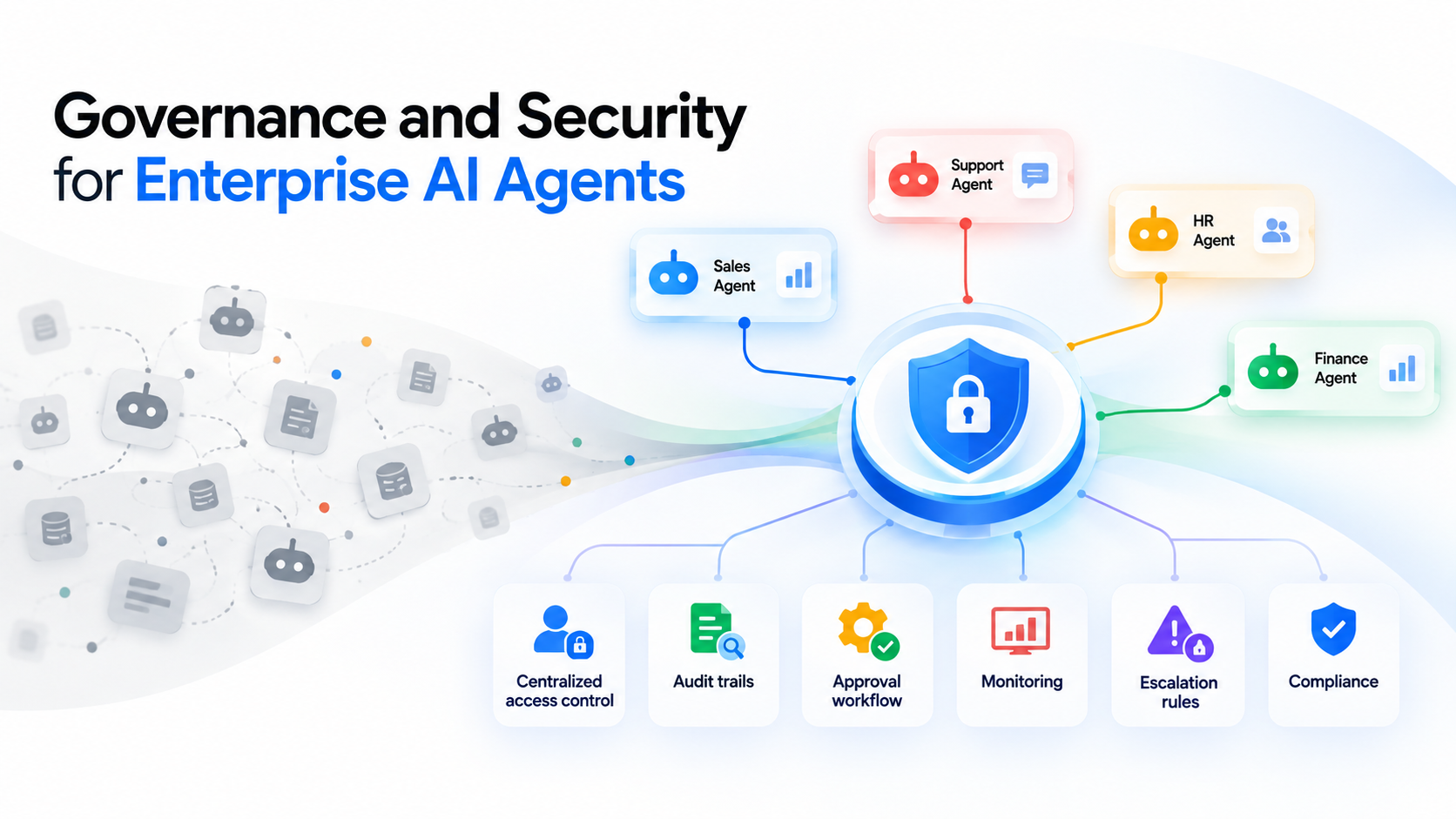
Every department that pilots an agent independently sales here, support there, HR somewhere else eventually produces the same question from security: which agents can access what data, and who approved that.
Without a shared governance layer, the honest answer is often "we're not entirely sure," which is a fine answer for a weekend hackathon and a serious problem the moment an agent touches customer or employee data in production.
Evonence builds agent governance into every Gemini Enterprise Agent Platform deployment from day one access controls, audit trails, and escalation rules rather than retrofitting it after the first security review flags a gap.
Ungoverned Agent Pilot vs. Governed Agent Deployment
| Ungoverned Agent Pilot | Governed Agent Deployment |
|---|---|
|
Access permissions set ad hoc per project
|
Access scoped centrally through Cloud Audit Logs and IAM
|
|
No consistent audit trail across agents
|
Every agent action logged through Gemini Enterprise Agent Engine
|
|
Escalation rules vary by team
|
Escalation thresholds defined and reviewed consistently
|
|
Security finds out about an agent after it's live
|
Security reviews agent scope before deployment
|
The Practical Path Over
Move 1: Establish the Governance Baseline
Before any new agent goes live, we define its data access scope, escalation rules, and audit requirements against a shared enterprise standard, not a per-project one.
Move 2: Deploy Under Central Monitoring
Agents deploy through Gemini Enterprise Agent Engine with logging routed to Cloud Audit Logs, giving security one place to review activity across every department's agents.
Example: a single dashboard shows what the sales agent, the support agent, and the HR agent each accessed last week.
Evonence's History With This Exact Problem
Three-Year Honoree
GCP Projects Delivered
Google Cloud Premier Partner
Questions Worth Answering Upfront
Key governance, operational, and security considerations for establishing agent compliance across enterprise deployments.
Defining the baseline framework typically takes 3–4 weeks; retrofitting existing agents to comply usually adds 2–3 weeks per agent.
No. Existing agents are typically brought under the governance framework by adjusting access scopes and adding logging, not rebuilt from scratch.
IAM controls who can access what; Cloud Audit Logs adds agent-specific monitoring — what an agent actually did with that access, across conversations and tool calls.
Evonence configures logging and access controls to align with ISO 27001 documentation expectations, though your organization's certification process will determine final audit scope.
Bring Your Agent Pilots Under One Standard
Schedule a free 30-minute Agent Governance Assessment with one of Evonence's Google Cloud-certified architects. We'll map every agent currently running and its access scope at no cost.