Research Synthesis Agents for Literature-Heavy R&D Teams
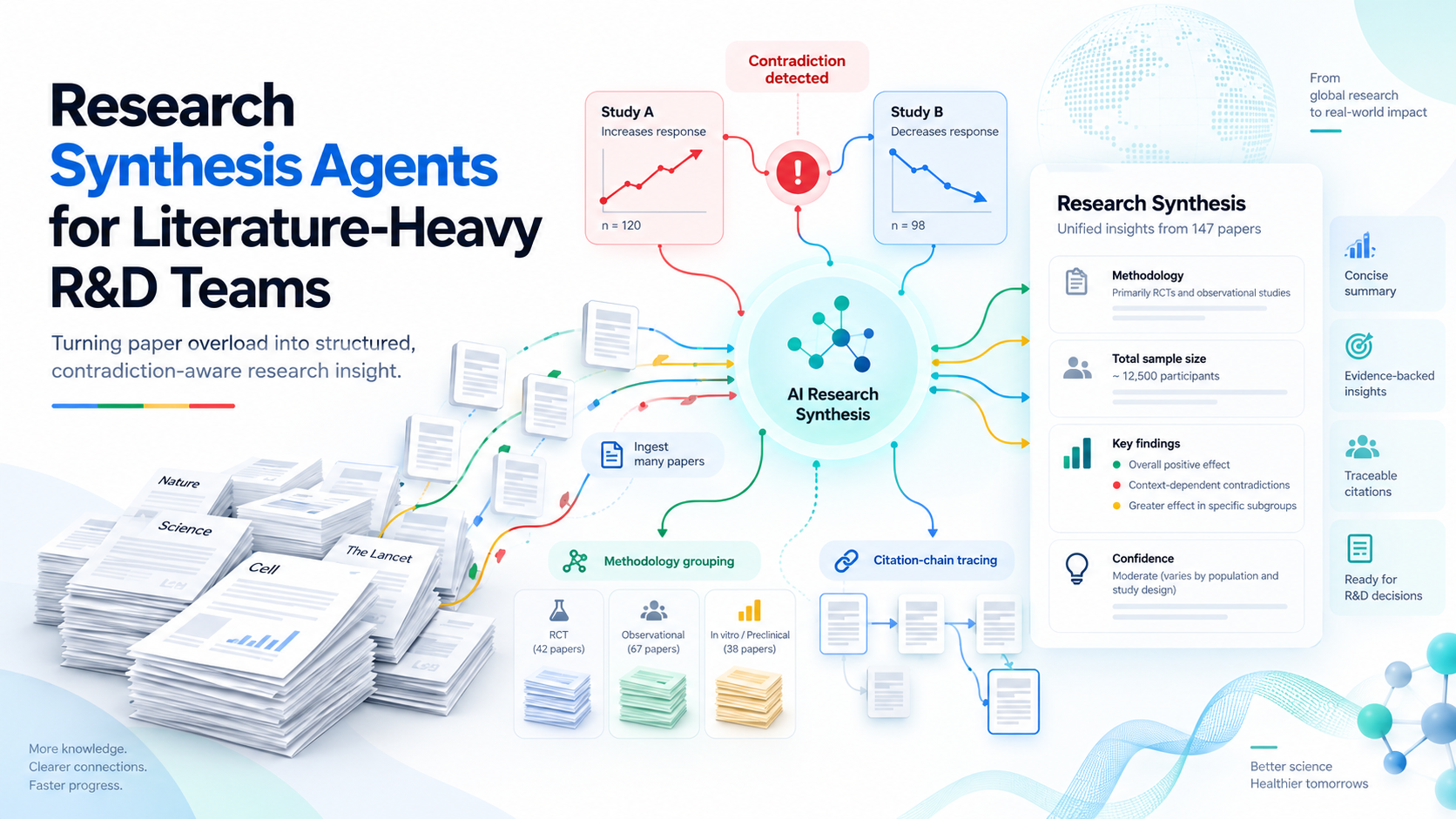
A research scientist with a backlog of 200 papers to review before a project kickoff isn't going to read all 200 carefully realistically, they'll skim half and hope the ones that matter are in that half. That's not a discipline problem. It's a volume problem, and volume problems don't get solved by trying harder.
A research synthesis agent built on the Gemini Enterprise Agent Platform changes the math, not the standard: it reads the full backlog, grounded through Document AI and Gemini Enterprise Search, and surfaces the papers most relevant to the specific research question, with a structured summary of each one's methodology, sample size, and key finding.
The harder and more useful part isn't summarizing any tool can shorten a paper. It's noticing when two papers in the same backlog disagree, and putting that disagreement in front of a researcher instead of quietly averaging it away. That's the part most literature tools get wrong, and it's where the rest of this post spends its time.
Evonence has built research synthesis agents for Life Sciences and Healthcare R&D teams where literature volume had become the actual bottleneck to starting new work, not lab capacity.
What's Actually Sitting in a Research Corpus
Before synthesis can happen, the agent needs something to synthesize from — and a real R&D corpus is messier than a folder of PDFs.
| Source Type | What the Agent Extracts |
|---|---|
| Peer-reviewed papers | Methodology, sample size, statistical approach, stated findings, and stated limitations |
| Preprints | Same fields as above, tagged as unreviewed so synthesis can weight them differently |
| Internal lab reports | Unpublished results and raw findings, kept separate from external literature in the summary |
| Patents and filings | Prior art and claimed methods, useful for freedom-to-operate questions alongside pure research review |
Where the Agent Actually Finds Signal
1. Cross-Paper Contradiction Detection
Two papers can both be methodologically sound and still reach opposite conclusions — different sample populations, different controls, different timeframes. The agent doesn't resolve that disagreement; it surfaces it explicitly, which is often more useful to a researcher than either paper's conclusion in isolation.
2. Methodology Fingerprinting
The agent groups papers not just by topic but by how they were studied — same assay type, same statistical approach, same class of control group. That surfaces a cluster of comparable studies a keyword search would scatter across unrelated results.
3. Citation-Chain Tracing
It follows which older, foundational papers a new cluster of research keeps citing, so a researcher can see the intellectual lineage behind a finding not just the finding itself, but what it was actually built on.
A Disagreement Worth Surfacing
Here's what that first capability looks like on an actual pair of papers pulled from the same backlog:
What the agent surfaces: The agent flags the sample-size and site-design gap between the two studies as the likely source of the disagreement, and surfaces both papers together in the summary — rather than reporting only the more recent or higher-citation paper as "the" answer, which is the failure mode a simpler summarization tool falls into.
Where This Still Needs a Human
— It doesn't judge which paper is right when two disagree — it surfaces the disagreement and the likely reason for it, and a researcher makes the call.
— It doesn't assess methodology quality on its own terms — a well-extracted summary of a flawed study is still a flawed study; the agent won't catch that a p-value was mis-reported.
— It doesn't guarantee corpus completeness — synthesis is only as good as what's been indexed, and a paper outside the corpus simply isn't part of the answer.
Where a First Pilot Usually Starts
Teams typically start by indexing the literature for one active research program rather than the whole department's archive, since that keeps the grounding data manageable and gives researchers on that program an immediate, measurable time savings before the agent's scope expands to other programs.
Where Evonence Has Done This Before
What Research Teams Ask Before Committing
How long does it take to deploy a research synthesis agent?
Can the agent work with internal, unpublished research alongside public literature?
What's the difference between this and a general-purpose AI search tool?
How does the agent decide two papers are actually in disagreement rather than just studying something slightly different?
Does the agent weight preprints the same as peer-reviewed papers?
How is sensitive or unpublished research data protected?
Ready to Clear Your Team's Literature Backlog?
Schedule a free 30-minute R&D Workflow Assessment with one of Evonence's Google Cloud-certified architects. We'll scope a pilot around your most time-pressured research question at no cost.