Synthesis, Not Search: Why You Are Misunderstanding Gemini Enterprise
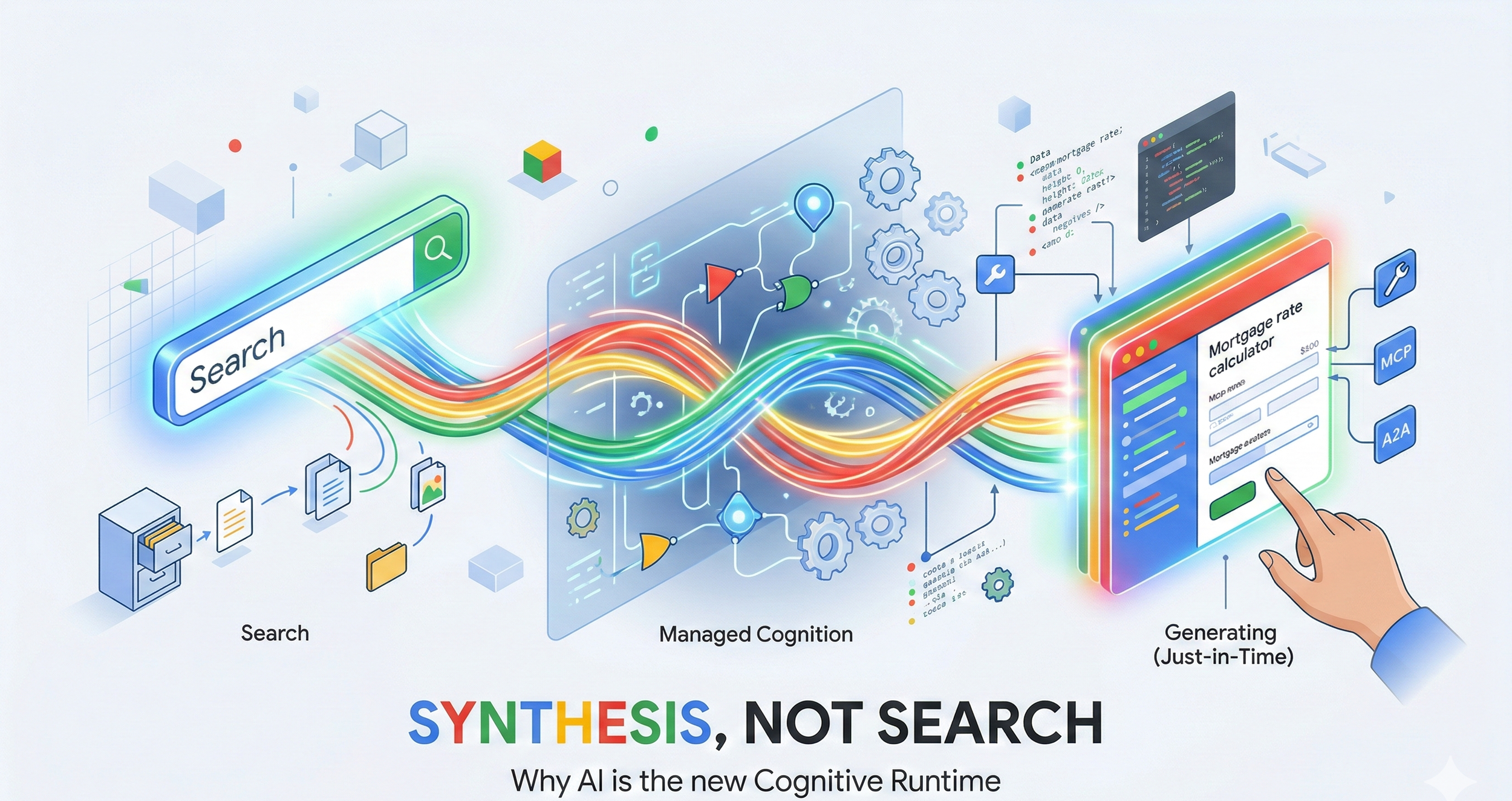
I continually observe a category error in the market regarding Google’s strategic pivot with Gemini Enterprise. When I speak with peers about this technology, they often categorize it as next-generation enterprise search. They see a text box, they see a retrieval mechanism, and they assume they are looking at a more expensive version of Google Cloud Search, Solr, or Elasticsearch.
This reductionist view is quite incorrect. To describe Gemini Enterprise as a search engine is to confuse a library card catalog with a research scientist. One points to information, the other synthesizes it to derive new conclusions.
We are not looking at a search tool. We are witnessing the deployment of a Cognitive Runtime.
The Shift from Static Code to Managed Cognition
To properly comprehend the architecture of Gemini Enterprise, we must explicitly abandon the vocabulary of search. Instead, we must look backward to one of the most vital historical leaps in software engineering: the birth of the managed runtime environment. In the 1990s, we saw the rise of runtimes like the JRE or CLR. These systems revolutionized development because they abstracted memory management and garbage collection from the developer. We stopped managing malloc() and free(); we let the runtime handle the allocation of resources.
Gemini Enterprise is the Runtime Environment for the intelligence age. It does not manage physical memory; it manages context.
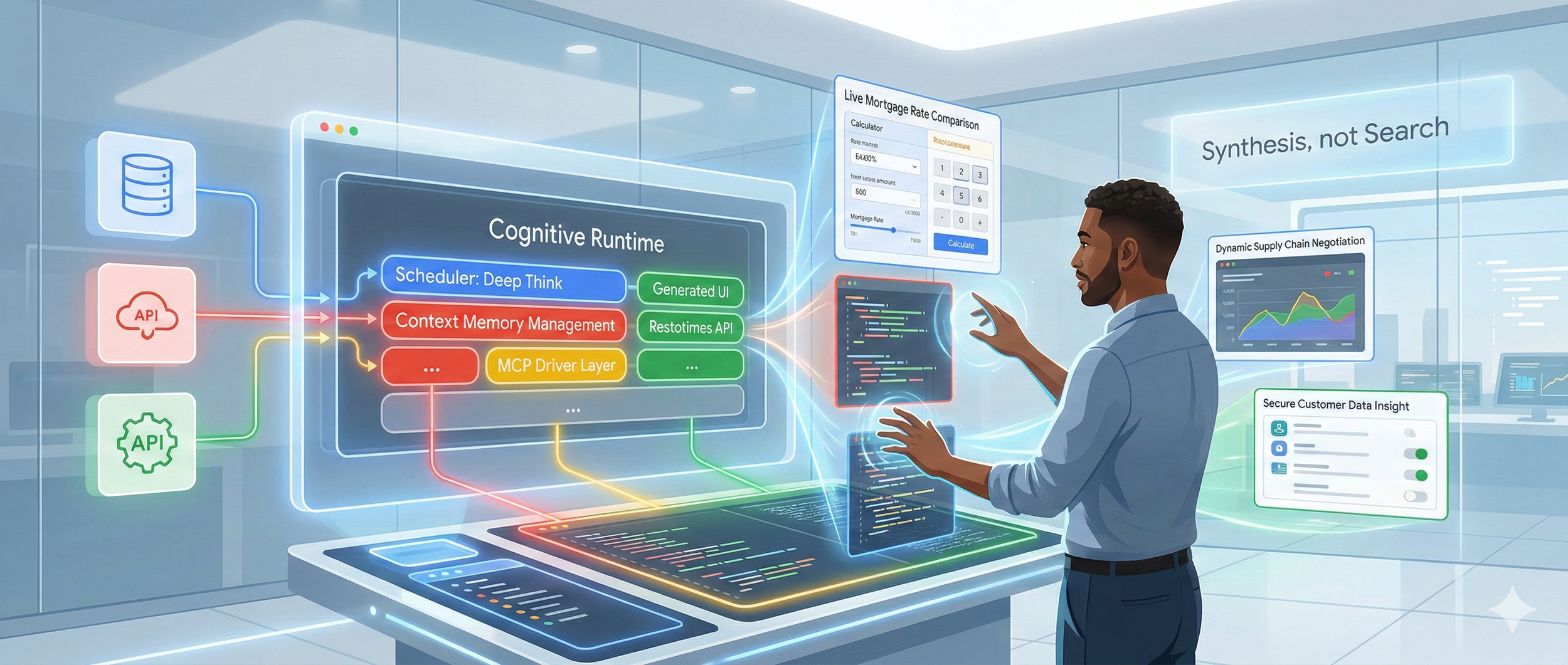
1. The Scheduler: Reasoning Allocation In a traditional runtime, the scheduler dictates which thread receives CPU cycles. In this Cognitive Runtime, Gemini 3.0 Pro acts as the scheduler for reasoning. Through its "Deep Think" capability, the system assesses the complexity of a request and dynamically allocates inference resources.
If a task requires complex logic, the runtime initiates a recursive reasoning loop. It pauses to validate its logic against internal benchmarks before it generates an output.
This is not search. It is the dynamic allocation of cognitive cycles.
2. Garbage Collection: The Context Economy The primary constraint of this new architecture is the context window: effectively the Heap of the agentic age. The runtime must manage what information remains in context and what it can safely discard. Gemini Enterprise utilizes a tiered memory architecture, paging information from long-term storage (vector databases) into the active context window only when necessary. It performs cognitive garbage collection to ensure the agent remains performant without hallucinating due to data overload.
The Return on our Service Strategy
For thirty years, we obsessed over API management and gateways. We did a lot of middleware. We properly (albeit with effort) treated business logic as discrete, secure services. This was not administrative overhead; it was preparation.
The Cognitive Runtime uses these APIs as its hands. It does not need us to hard-code connections between systems. It simply reads the API definition, understands the capability, and executes the request. We did not build a bureaucracy of services; we built the instruction set this new engine executes.
Universal Bindings (MCP) The Model Context Protocol (MCP) functions as the universal binding layer. In the past, if we wanted to connect an application to a database, we required some level of a bespoke integration or provided API. Now, developers build an MCP Server that exposes a tool's capabilities in a standardized format. Gemini does not need to know the schema of every database; it simply mounts the MCP server.
Message Passing (A2A) Furthermore, the Agent2Agent (A2A) protocol serves as the native message-passing interface for this runtime. It allows a Sales Agent from one vendor to negotiate directly with a Supply Chain Agent from another. The runtime handles the handshake and data transfer without human intervention. This eliminates the need for bespoke wiring between applications.
JIT Compilation for Interfaces
Perhaps the most striking divergence from Search proper is how the system handles the user interface. In a traditional application, the frontend is a static artifact pre-compiled by engineers.
Gemini Enterprise employs a form of Just-in-Time (JIT) compilation for the UI. It employs Generative UI to construct interfaces on the fly. If a user asks to compare mortgage rates, the system does not retrieve a link to a calculator: it writes the code for a calculator, retrieves the real-time interest rates via MCP, and renders the interactive component in the stream.
The interface is no longer a fixed destination; it is an ephemeral artifact generated to satisfy a specific intent.
The Death of Syntax
We waste extensive engineering cycles fighting the compiler. We hunt for missing semicolons or debate the merits of specific libraries. This defines inefficiency.
Our cognitive runtime eliminates this friction. We are witnessing the next evolution and abstraction layer. Just as we stopped managing memory addresses to write in Java, we now stop managing syntax to write in Gemini.
The industry calls this vibe coding, a trivial name for a profound shift. It is not about ‘vibes’; it is about intent. In environments like Google Antigravity, my engineers do not write the recursive loop. They define the exit condition. They do not write the API client. They define the data schema they require. The developer is no longer a bricklayer. The developer is the foreman. They do not type characters; they orchestrate agents to build the solution.
The Architectural Imperative
If you view Gemini Enterprise merely as a search engine, you will inevitably relegate it to a utility. You will index your static repositories, provision a basic chat interface, and subsequently question the marginal return on your investment.
Conversely, if you properly comprehend it as a Cognitive Runtime, you will recognize it as foundational infrastructure. You will architect the cognitive flows that dictate your operational velocity.
Do not procure this technology simply to retrieve support tickets or surface stale documentation. Adopt it as the managed cognitive environment upon which the future of your enterprise will execute.