From Reactive to Predictive: How Gen AI is Powering the Next Generation of OTA Updates
The Billion-Dollar Bug: Why Recalls Are No Longer Physical
In the era of the Software-Defined Vehicle (SDV), a "recall" rarely involves a loose bolt or a faulty transmission block. Today, a recall usually means a few lines of anomalous code.
Yet, the automotive industry continues to treat software bugs with the same legacy workflows used for mechanical failures: wait for a critical mass of customer complaints, spend months investigating the root cause, and ultimately issue a massive, headline-grabbing recall. This reactive cycle destroys brand equity, frustrates drivers, and costs OEMs billions annually in warranty claims and logistical overhead.
What if your fleet could diagnose its own anomalies before the driver ever experienced a symptom?
At Evonence, we are partnering with automotive leaders to deploy Fleet Intelligence Agents AI-native systems built on Google Cloud that analyze telemetry data at an unprecedented scale, moving OEMs from "Reactive Recalls" to Predictive Over-the-Air (OTA) resolutions.
The Problem: The "Haystack" of Petabyte Telemetry
Modern connected cars stream gigabytes of data every single hour. Multiply that across a fleet of millions, and you are no longer dealing with data; you are dealing with petabytes of noise.
The Data Deluge: Traditional 3rd-party analytics tools choke on this volume. They are built to show you historical averages, but they completely miss the microscopic anomalies hiding in the margins.
The Pattern Gap: A critical software bug might only trigger under a highly specific, rare combination of conditions (e.g., "ADAS system latency spikes when braking while turning left at 40mph in heavy rain"). Human engineering teams, no matter how talented, simply cannot manually sift through millions of unstructured system logs to find this invisible pattern.
The Solution: The Fleet Intelligence Agent
To solve this, Evonence deploys a Gen AI agent specifically engineered to hunt for these "needle in the haystack" failure patterns.
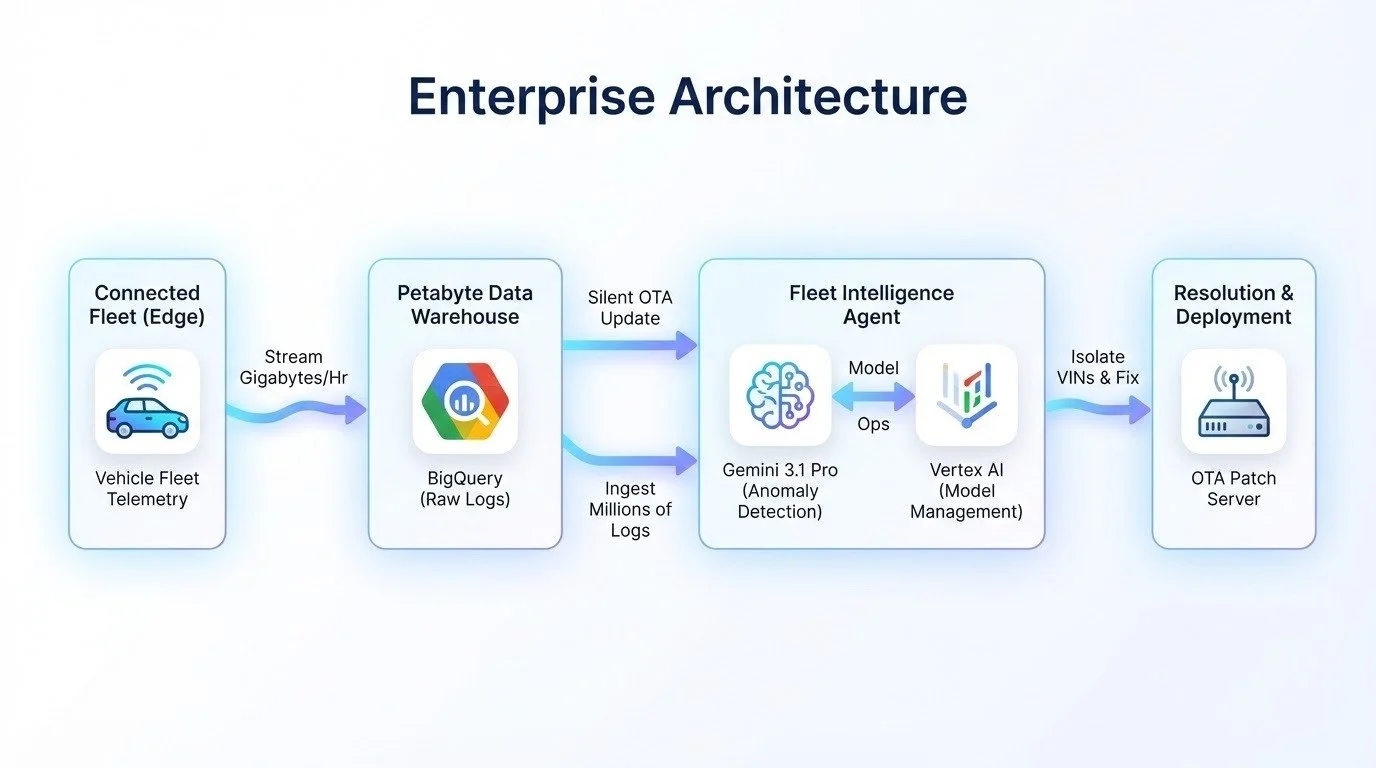
Here is how the Predictive OTA workflow operates natively within the Google Cloud ecosystem:
Ingest & Centralize (BigQuery): We stream raw, unstructured, and structured telemetry data from the entire fleet into BigQuery. Because BigQuery is a serverless, petabyte-scale data warehouse, it handles massive data ingestion without the operational overhead of managing clusters.
Analyze & Reason (Gemini 1.5 Pro): This is the breakthrough. Instead of exporting data to a vulnerable third-party LLM, we bring the AI to the data. Using Gemini 1.5 Pro’s massive 2-million token context window, the system ingests thousands of complex crash logs, sensor readings, and error reports simultaneously. The AI reasons across this vast dataset to spot the hidden correlations humans missed: "95% of these ADAS latency faults occurred only when the battery state-of-charge was below 20% and the infotainment system was rebooting."
Resolve & Deploy (Targeted OTA Fix): The agent isolates the specific affected Vehicle Identification Numbers (VINs) and triggers a targeted, automated Over-the-Air software patch via your connected vehicle platform—fixing the bug before it causes a safety incident or generates a customer complaint.
Under the Hood: The 1P Consolidation Advantage
Many OEMs attempt to build this using a fragmented stack—storing data in one cloud, exporting it to a third-party AI vendor, and managing security through another. This creates immense data egress costs, latency, and massive security vulnerabilities.
At Evonence, we champion a consolidated, 1st-party Google ecosystem approach:
Data Gravity & Cost Efficiency: By keeping telemetry in BigQuery and applying Vertex AI natively, you eliminate the massive egress fees associated with moving petabytes of data to third-party AI models.
Zero-Trust Security: Utilizing Google Cloud Identity ensures that your proprietary vehicle data and customer telemetry never leave the secure Google perimeter, maintaining strict compliance with GDPR and emerging automotive data regulations.
Vertex AI Lifecycle Management: Vertex AI acts as the control plane, managing the lifecycle of these predictive models and ensuring they remain accurate as your vehicle software continuously evolves.
Why This Wins
Many competitors offer basic "Fleet Analytics." They provide a dashboard with a pie chart showing fleet health. Our mandate is Preemption.
We believe the goal is not to analyze the crash after it happens; the goal is to prevent it entirely. By combining BigQuery's unmatched scale with Gemini's deep reasoning capabilities, Evonence turns your vehicle telemetry from a massive storage liability into a proactive safety asset. You fix the car while it sits silently in the owner's driveway, and the driver never even knows there was a problem.
The Bottom-Line Business Impact
Slash Warranty & Service Costs: Eliminate the logistical nightmare and expense of physical dealer visits for strictly software-related issues.
Brand & Revenue Protection: Avoid the catastrophic PR disaster of a public safety recall by patching vulnerabilities silently and swiftly.
Accelerated R&D Loop: Feed real-world, edge-case failure data instantly back to the engineering team to improve the software architecture of the next model year.
Is your fleet data gathering dust, or is it gathering intelligence?
Stop reacting to software failures. Contact Evonence today to pilot a Connected Vehicle Intelligence architecture tailored to your fleet.