The End of the "Regional Delay": Launch Your Content Globally on Day One
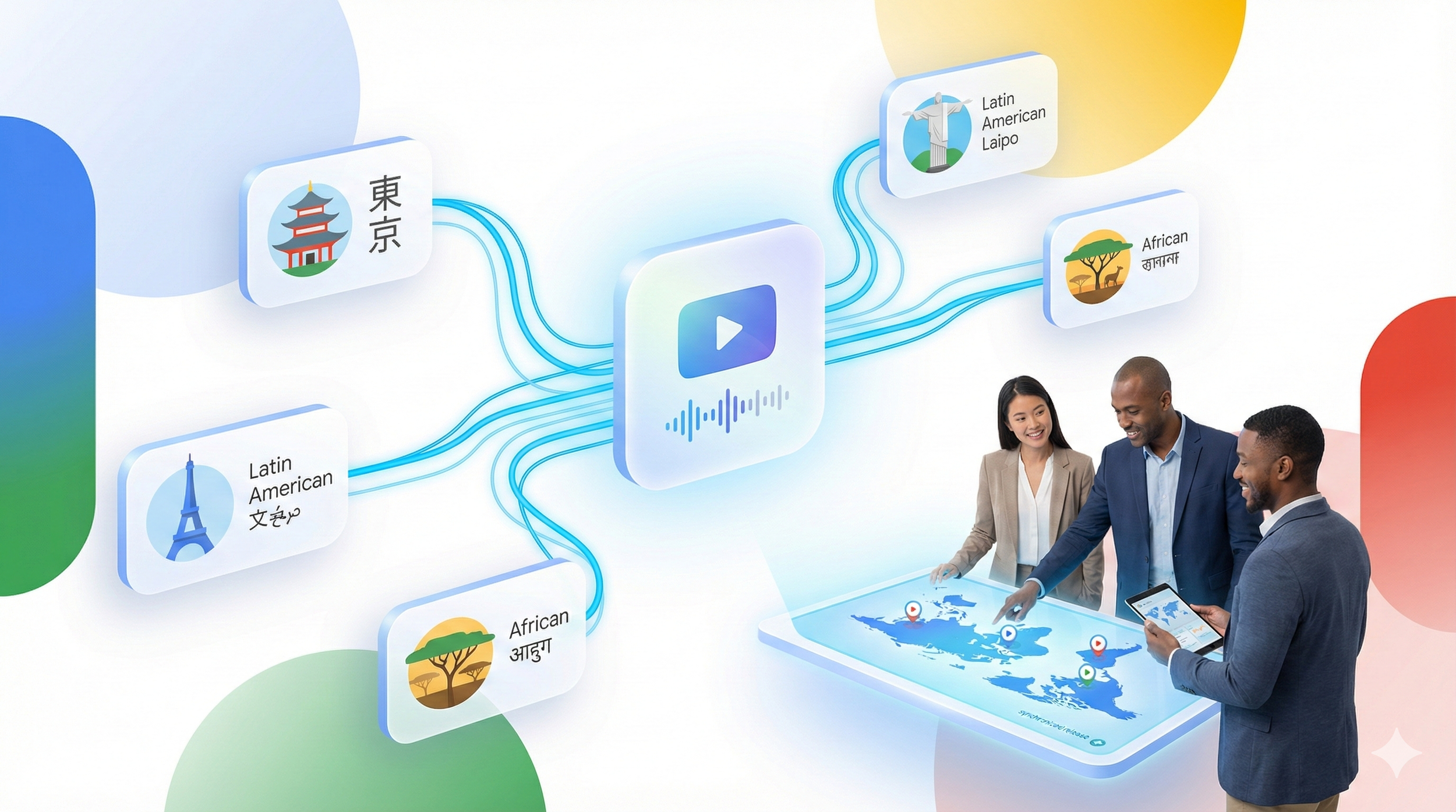
In the streaming era, a "global launch" often isn't truly global. While your US audience watches the premiere, your audiences in Brazil, Japan, and France are often stuck waiting weeks for dubbed versions—or worse, settling for low-quality subtitles because professional localization was too expensive or slow to finish in time.
The bottleneck isn't the creative content; it's the localization supply chain.
Traditionally, localization is a fragmented, linear mess:
Transcribe the audio to text.
Translate the text (often losing emotional nuance).
Hire voice actors or use robotic Text-to-Speech (TTS).
Manually Sync the new audio to the video timeline.
This process is costly, slow, and prone to "context errors" where a translator misinterprets a scene they can't see.
At Evonence, we are helping media companies break this bottleneck with the Global Localization Agent.
The Solution: An Agent That "Watches" Before It Translates
Unlike traditional translation tools that only look at text, our Global Localization Agent is multimodal. It doesn't just read a script; it watches the video and listens to the audio simultaneously.
By ingesting the native video file, the agent understands:
Context: Is the speaker angry or whispering? (Audio cues)
Scene: Are they pointing at an object? (Visual cues)
Timing: How fast do they need to speak to match the on-screen lip movement?
The result is a localized asset generated in one pass—subtitles, dubbed audio, and metadata—ready for human final review in minutes, not days.
Under the Hood: The "Pixel-to-Wave" Advantage
Why is this use case winning against competitors? It comes down to Google Cloud’s unique multimodal architecture.
1. The Engine: Gemini 3 Flash (Multimodal Native)
Most competitor stacks (like AWS) force you to chain disparate services: AWS Transcribe → AWS Translate → Amazon Polly. Context is lost at every "hop."
Gemini 3 Flash, however, is natively multimodal. It processes the raw video pixels and audio waveforms together. It doesn't need to "transcribe" to text first to understand what is happening. This preserves the emotional tone—if the actor is crying in the video, the generated French audio will reflect that sadness, not just read the words flatly.
2. The Workflow: Vertex AI Agent Engine
We use Vertex AI to orchestrate the entire pipeline. The agent ingests the master file, generates the localized tracks, and even outputs a "confidence score" for every scene. This allows your human editors to skip the 90% of content that is perfect and focus only on the 10% that needs creative nuance.
The Migration Advantage: Why Switch from AWS?
Many media ops teams have built "Frankenstein" workflows on AWS using Lambda functions to glue Transcribe, Translate, and Polly together. These pipelines are brittle, expensive to maintain, and fundamentally limited by the "text-only" middle layer.
Migrating to a Google Cloud Agentic approach removes the glue code. You replace five different API calls with a single multimodal prompt to Gemini. The result is lower latency, lower compute costs, and higher quality output because the AI "sees" the video it is dubbing.
The Evonence Approach: A Global Content Factory in 4 Weeks
We know that in media, "good enough" isn't good enough. Quality is paramount.
That is why our Global Localization Accelerator includes a "Human-in-the-Loop" review interface. We don't aim to replace your editors; we aim to give them superpowers.
Week 1-2: Ingest your historical content and brand glossaries.
Week 3: Tune Gemini 2.5 Flash on your specific audio profiles.
Week 4: Deploy the automated pipeline for pilot testing.
The Goal: Launch in Tokyo the same minute you launch in New York.
Stop making your global audience wait. Contact Evonence to see our Multimodal Localization Agent in action.