Stop the Chatbot Amnesia: How to Build a "Never-Forget" VIP Shopper Agent in 6 Weeks
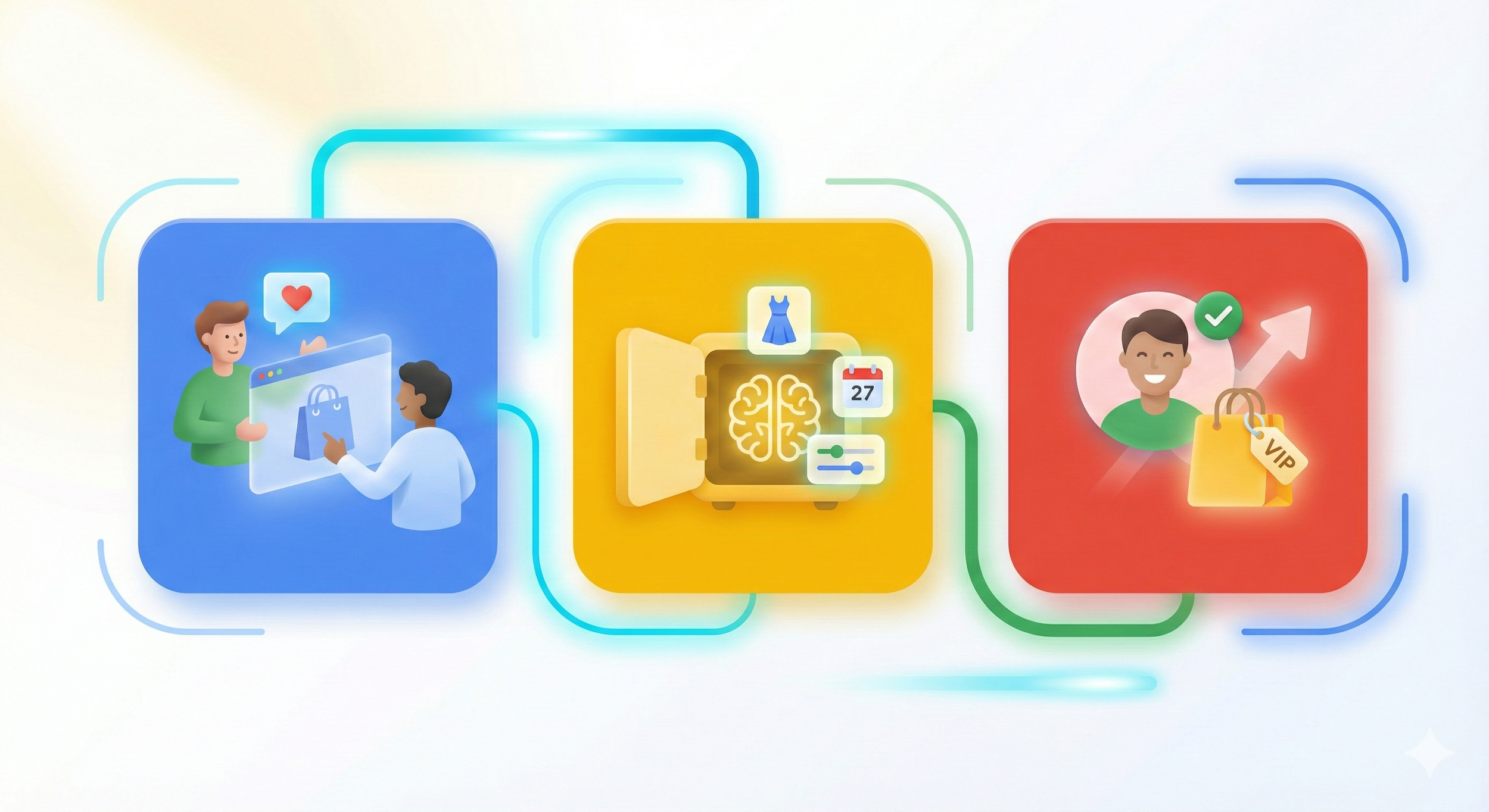
Imagine your top-tier customer, let’s call her Sarah. She spends $5,000 a year with your brand. She knows exactly what she likes, her sizes are consistent, and she has a specific return history (e.g., "wool makes me itch").
Yet, every time Sarah opens your e-commerce chat window, she is greeted by a cheerful, generic bot that has absolutely no idea who she is.
Bot: "Hi there! How can I help you today?"
Sarah: "I'm looking for a dress for a summer wedding, similar to the blue silk one I bought last July, but maybe in a warmer tone."
Bot: "I can help with dresses! What size are you looking for? And do you have a preferred price range?"
Sarah sighs. She has to re-enter her size. She has to describe her style again. The bot has "amnesia." Despite all the data you have on Sarah in your CRM and order history, your front-line digital experience treats this VIP like a complete stranger.
This friction isn't just annoying; it erodes loyalty. A VIP customer deserves a VIP experience, not a generic interrogation.
This pattern shows up consistently across mid-market and enterprise retailers, fashion, specialty retail, and DTC brands. Customer data exists across CRM, order history, and support systems, but is never operationalized in real time. In most cases, loyalty programs and purchase history are technically available, yet disconnected from conversational touchpoints, resulting in digital experiences that reset on every visit.
At Evonence, we are helping retailers solve this exact problem by deploying the next generation of AI: The "Never-Forget" Stateful Concierge Agent.
The Solution: An Agent with Long-Term Memory
The difference between a standard Gen AI chatbot and an agentic solution lies in statefulness.
In practice, statefulness means separating short-term conversational context from durable customer memory, stored, governed, and queried independently of the LLM session itself.
A standard chatbot lives in the moment; once the session closes, the context evaporates. A Stateful Concierge Agent, however, builds a cumulative understanding of the customer over time.
When Sarah connects next time, the experience is radically different:
Agent: "Welcome back, Sarah! Great to see you again. Are you still loving that blue silk dress from last summer?"
Sarah: "Yes! Actually, I'm looking for something similar for another wedding, maybe in terracotta or gold."
Agent: "Got it. Knowing you prefer a size 8 in silk blends and tend to avoid styles that are too tight across the shoulders, I’ve found three options..."
The agent didn't just answer a question; it leveraged historical context to provide proactive, personalized service.
Recommended Read: Why Every Retailer Needs to Know About Gemini Enterprise
Under the Hood: Google Cloud’s Secret Weapons
Building this level of memory historically required complex custom engineering. Today, Google Cloud has simplified this dramatically with two key components we use to build these agents in weeks:
1. The Brain: Gemini 3 Flash
We utilize Google’s latest model, Gemini 3 Flash, for its incredible speed and low latency. In retail, responsiveness is critical, customers won't wait ten seconds for an answer. Flash provides instantaneous, natural, and highly accurate conversational abilities at a fraction of the cost of "Pro" models.
2. The Memory: Vertex AI Memory Bank
This is the game-changer. Vertex AI Agent Builder provides managed mechanisms to maintain long-term "state."
Instead of relying solely on the immediate conversation history, the agent securely accesses a structured "memory bank" of the customer's past interactions, preferences, sizes, and feedback. It inherently understands the context: "She returned wool last time because it was itchy, so I shouldn't recommend wool today."
The Migration Advantage: Moving Beyond OpenAI’s Limitations
Not all customer data should, or can, be remembered indefinitely. Effective concierge agents require clear memory boundaries, consent-aware retention policies, and alignment with privacy regulations such as GDPR and CCPA. Successful implementations focus on high-value preference signals while avoiding over-collection that could erode customer trust.
Many retailers started their Gen AI journey with OpenAI. However, a lot have hit a wall regarding reliable, long-term statefulness. When APIs change or "Assistants" features are deprecated, engineering teams are left scrambling to build their own memory infrastructure.
At Evonence, we view this as an opportunity to upgrade. Migrating to Google Cloud’s stack offers a more robust, enterprise-grade solution for managed memory. We help clients move off brittle, custom-built state solutions onto Vertex AI’s managed infrastructure, ensuring your agent’s memory is reliable, secure, and scalable.
The Evonence Approach: A Quick Win for CX
We know retailers are wary of long, expensive IT projects. That’s why we’ve architected this use case as a "Quick Win."
Because we leverage managed Google Cloud Retail Solutions rather than building complex infrastructure from scratch, we can take a retailer from discovery to a pilot production agent in 6 to 8 weeks.
The Goal: Stop amnesia. Your customers remember every interaction they have with your brand. It’s time your AI returned the favor.
Recommended Read: Evonence: Your Premier Google Cloud Partner for Retail Transformation
Next Steps: Evaluate Stateful CX Readiness
If your chatbot already has access to customer data but still behaves like a stranger, the issue is likely architectural, not model quality.
Retail Concierge Readiness Review
Assess how customer memory, consent, and personalization signals are currently handled across your digital channels, and identify where a stateful agent can deliver measurable CX lift within weeks, not quarters.
Are you ready to treat your digital customers like VIPs? Contact Evonence today for a demo of our Retail Concierge Agent capabilities.