The Most Expensive Room in the Building: The Silent Cost of the Empty Operating Room
The Hidden Financial Engine of Your Hospital
In any hospital system, the Operating Room (OR) is the financial engine. It is also the bottleneck.
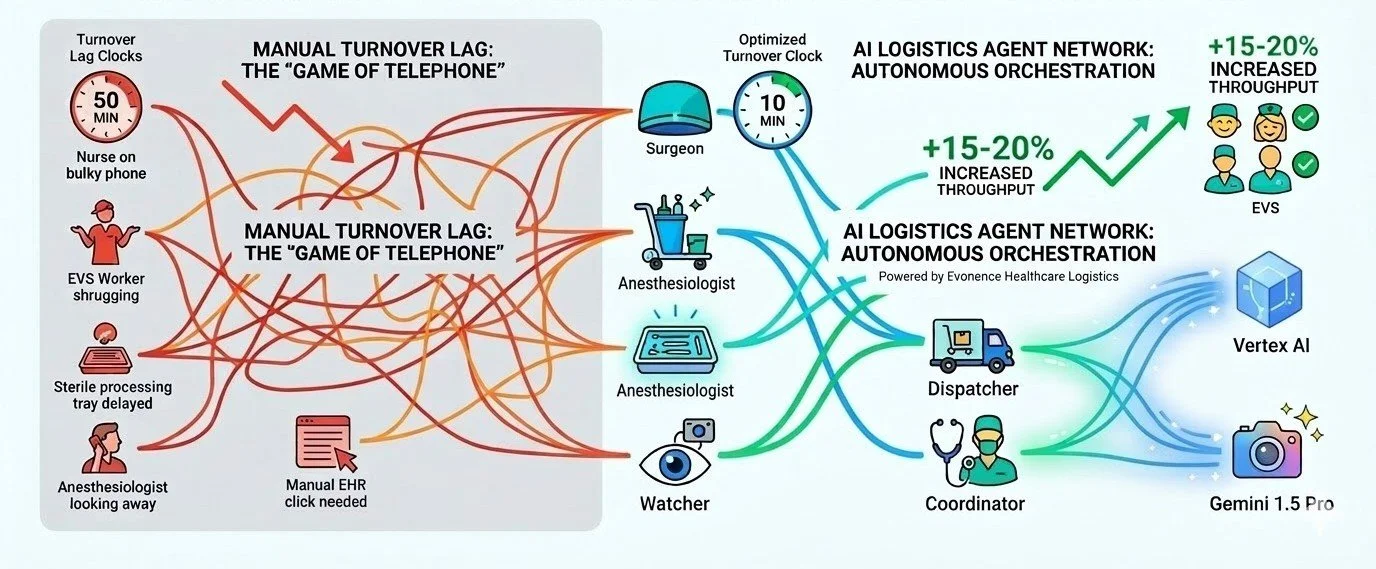
Every single minute an OR sits empty during business hours represents lost revenue—often valued at hundreds of dollars per minute. Yet, despite best efforts, hospitals are continuously plagued by "turnover lag." A surgery finishes at 10:00 AM, but the next patient does not enter until 10:50 AM.
Why? Because of the human logistics chain. The nurse has to call Environmental Services (EVS). EVS is busy elsewhere in the building. Sterile processing is running ten minutes behind on the instrument tray. The anesthesiologist stepped out for coffee because they did not know the room was ready.
At Evonence, we are solving this coordination crisis by deploying the Operating Room Flow Commander—a Real-Time Logistics Agent that orchestrates the dance of surgery without the frustrating game of "telephone."
The Problem: The Visibility Gap
Current scheduling software tells you when the surgery should end. It rarely tells you when it actually ended.
Manual Triggers: Relying on nurses to manually click "Surgery Complete" in the Electronic Health Record is unreliable during a busy case closing. This action is often the last priority.
Siloed Communication: EVS, Sterile Processing, and Anesthesia live in different communication channels (pagers, phones, overhead announcements). This fragmentation breeds delays and missed connections.
The Solution: The Agent-to-Agent Network
We move from a "Push" system (humans calling humans) to an Autonomous Orchestration system. We deploy specific AI Agents for each function that negotiate directly with one another.
Here is the workflow for a "Smart Turnover":
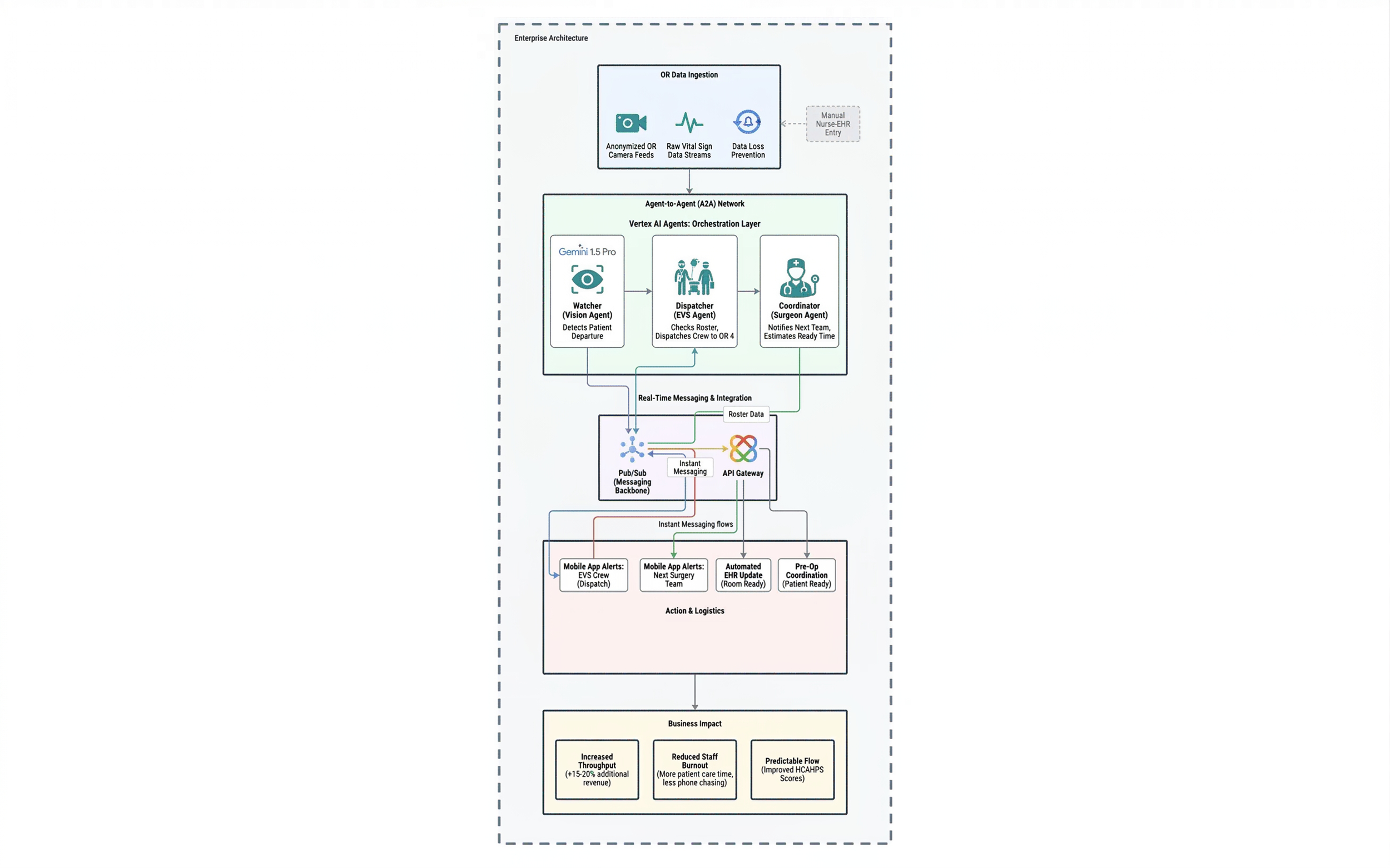
The Watcher (Vision Agent): Using privacy-compliant, blurred computer vision feeds (or analyzing anonymized vital sign data streams), the Artificial Intelligence detects that the patient has left the room.
The Dispatcher (Environmental Services Agent): The "Room Agent" instantly pings the "EVS Agent." It doesn't just send a text; it checks the roster, finds the nearest available cleaning crew member, and dispatches them to Operating Room 4 immediately.
The Coordinator (Surgeon Agent): Simultaneously, the system notifies the next surgeon and anesthesiologist: "Room 4 cleaning started. Estimated ready time: 10:22 AM. Please proceed to Pre-Op."
This seamless system, visualized in the infographic below, eliminates friction and removes the need for manual communication:
Under the Hood: The Google Cloud Tech Stack
This solution requires extremely low latency and true multimodal understanding, built on a powerful foundation:
Vertex Artificial Intelligence Agents: The core orchestration layer that allows different "bots" (Cleaning, Surgery, Inventory) to exchange messages and trigger workflows.
Gemini 1.5 Pro (Vision Artificial Intelligence): We utilize multimodal capabilities to interpret unstructured data—like video feeds or complex sensor logs—to determine the exact status of a physical room in real-time. This provides the crucial real visibility.
Publish-Subscribe Network: The messaging backbone that ensures alerts are delivered instantly to mobile devices, ensuring zero latency in communication.
Why This Wins
Most competitors try to sell "Better Scheduling Software." But a schedule is just a guess.
Our approach is Real-Time Logistics.
We don't just plan the day; we manage the minute. By removing the friction of manual phone calls and pages, we compress the "dead time" between cases. We believe that if you can save just ten minutes per turnover across twenty Operating Rooms, you have effectively built a new hospital wing without pouring a single drop of concrete.
The Business Impact
Increase Throughput: Squeeze 1–2 additional procedures into the daily schedule per room—increasing revenue by 15–20%.
Reduce Staff Burnout: Nurses spend less time chasing people on the phone and more time on high-value patient care.
Predictable Flow: Surgeons and patients experience fewer delays, improving overall satisfaction scores (HCAHPS).
Is your hospital losing millions in the gap between surgeries?
Contact Evonence today to see how our Healthcare Logistics Agents can optimize your OR flow.