Confessions of a Search Supremacist: Why AI Brought Me Back to Folders
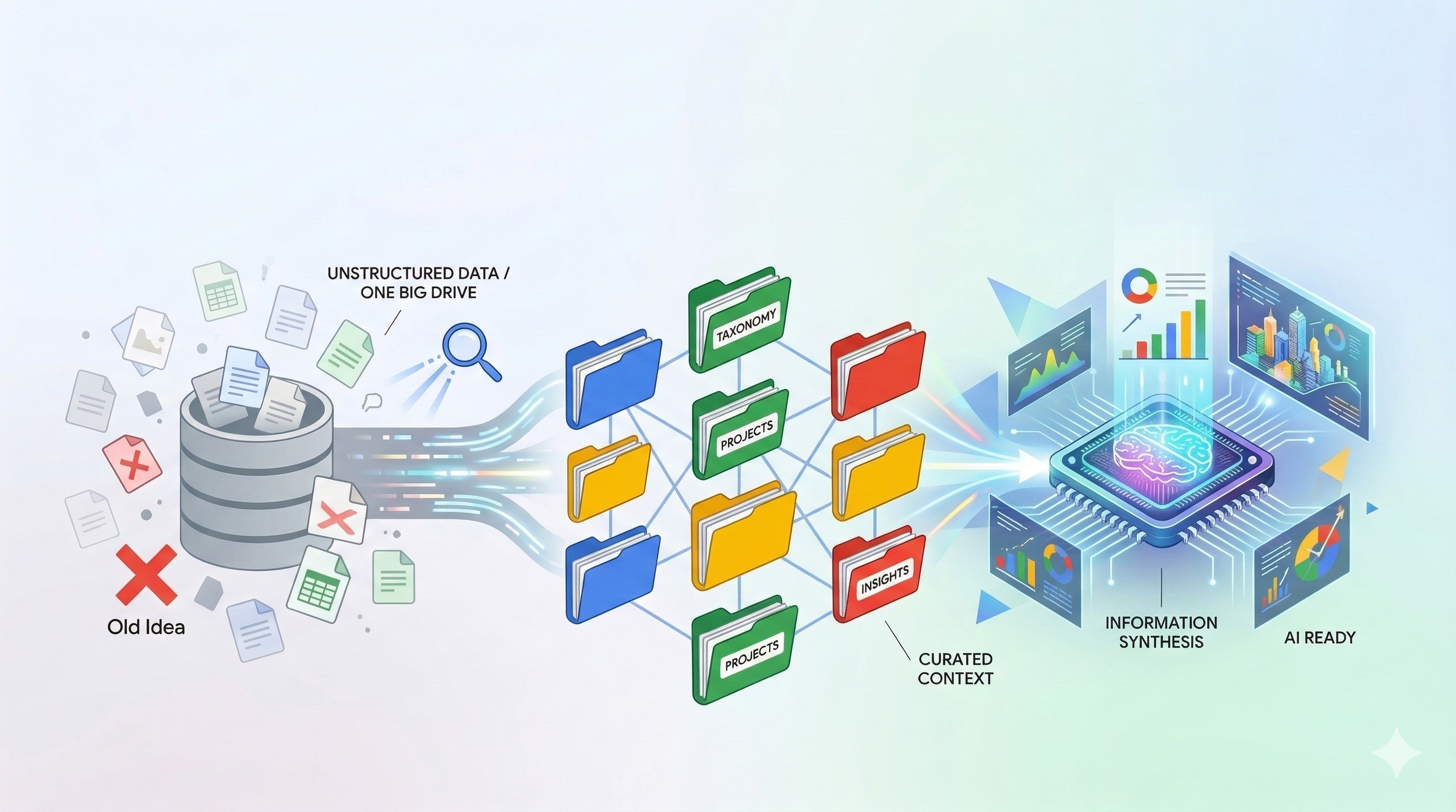
A public confession on context, cognitive collapse, and the generative AI
There is a unique, quiet embarrassment in realizing you have been aggressively, publicly wrong about something for the better part of a decade.
For years, I was a militant evangelist for the One Big Drive. I actively dismissed the digital folder as a skeuomorphic relic. It was a psychological safety blanket for professionals who unconsciously missed the reassuring clatter of a physical filing cabinet.
My gospel was unapologetic: "orphaned" files were the organic future. I wielded computational architecture against taxonomy loyalists, arguing that when modern search can parse at the exbibyte scale of data in subsecond search-time, human categorization is a wasted effort. I would frequently joke that "taxonomization" literally has the word "tax" in it. Why build nested hierarchies when an algorithm can summon an orphaned file from a massive data lake instantly? I firmly believed this was the absolute pinnacle of enterprise efficiency.
I was entirely confident. And, I discovered, I was completely shortsighted.
What I failed to predict was how rapidly the rules of digital physics would change. The arrival of advanced LLMs (Google’s Gemini in particular) completely inverted how we interact with stored knowledge. We are no longer simply hunting for a single orphaned document. To extract actual value from these AI models, we must curate bounded contexts for them to synthesize.
The folder isn't dead. It has just been resurrected as the essential framework for communicating with our new artificial counterparts.
The Professorial Justification: Cognitive Friction and Inodes
I didn't just preach this anti-folder crusade; I backed it up with what I considered unassailable cognitive and computational logic.
The Cognitive Friction: Forcing humans to maintain elaborate, nested hierarchies is a massive drain on working memory. Every time a user has to decide where a file belongs, they suffer micro-decision fatigue. By transitioning to search-based retrieval, we effectively bypass these constraints, replacing the taxing labor of spatial memory with the sheer efficiency of linguistic recognition. Why remember where you put it when you can just ask the machine for what it is?
The Computational Reality: The structural argument was even stronger. At the core of most filesystems, a directory (or folder) is, ultimately, just another file. Read inode. The modern digital "folder" was merely a skeuomorphic illusion designed to make humans feel better about their data. It was a comforting visual crutch held over from the era of physical filing cabinets. Search algorithms had, mathematically speaking, rendered that illusion completely obsolete.
The Generative Paradigm Shift
My philosophically compelling argument against the folder failed soon after generative artificial intelligence arrived. The fundamental shift we are experiencing is deeply behavioral. I rarely if ever go looking for just a single file anymore. We have moved entirely from an era of Information Retrieval to an era of Information Synthesis.
When the ultimate goal is high quality output, leaving data as orphaned objects no longer makes any sort of sense. Advanced LLMs like Gemini require curated collections of files. I now prefer to group all my past notes, Google Meets transcripts, documents, and images into unified sources. I need collections of things now more than ever. The true objective is broad- sourcing data to achieve unparalleled synthesis for my Gemini output.
The Organizational Hive Mind
This realization does not just apply to my personal digital workspace. Its implications scale exponentially when we consider the broader enterprise.
If individual folders provide the necessary context boundaries for personal AI outputs, then enterprise structures like Shared Folders and Shared Drives have suddenly become essential infrastructure for the future. We are no longer simply sharing files so a human colleague can passively read a document. We are actively structuring interconnected networks of knowledge. We are curating bounded sources of truth that an organizational AI can safely draw upon to ensure accurate synthesis at the corporate scale.
A meticulously organized Shared Drive is no longer an administrative chore. It is the very foundation of an organization's collective intelligence.
Vindicating the Taxonomists
There is an irony in realizing that the practice I spent years trying to dismantle is now the key to unlocking the future of knowledge work.
It is time to resurrect the folder. We are not doing this to appease a lingering nostalgia for digital filing cabinets, nor are we retreating to outdated methods of data management. We are returning to structure because curated context is the ultimate currency of the generative era. The ability to point an advanced LLM like Gemini toward a meticulously organized directory yields exponential returns, saving immense amounts of time and transforming scattered data points into synthesized, high-value intelligence.
To the steadfast taxonomists, the digital curators, and the stubborn rejecters of the One Big Drive: you have been entirely vindicated.
Keep categorizing. Keep building those nested hierarchies with the quiet intentionality you never abandoned. The era of structure has returned. Only this time, you aren't just organizing files to assist your own memory; you are architecting the foundational context that gives generative intelligence its power.