Why Startups Must Prioritize Cloud Infrastructure Migration Before Series A
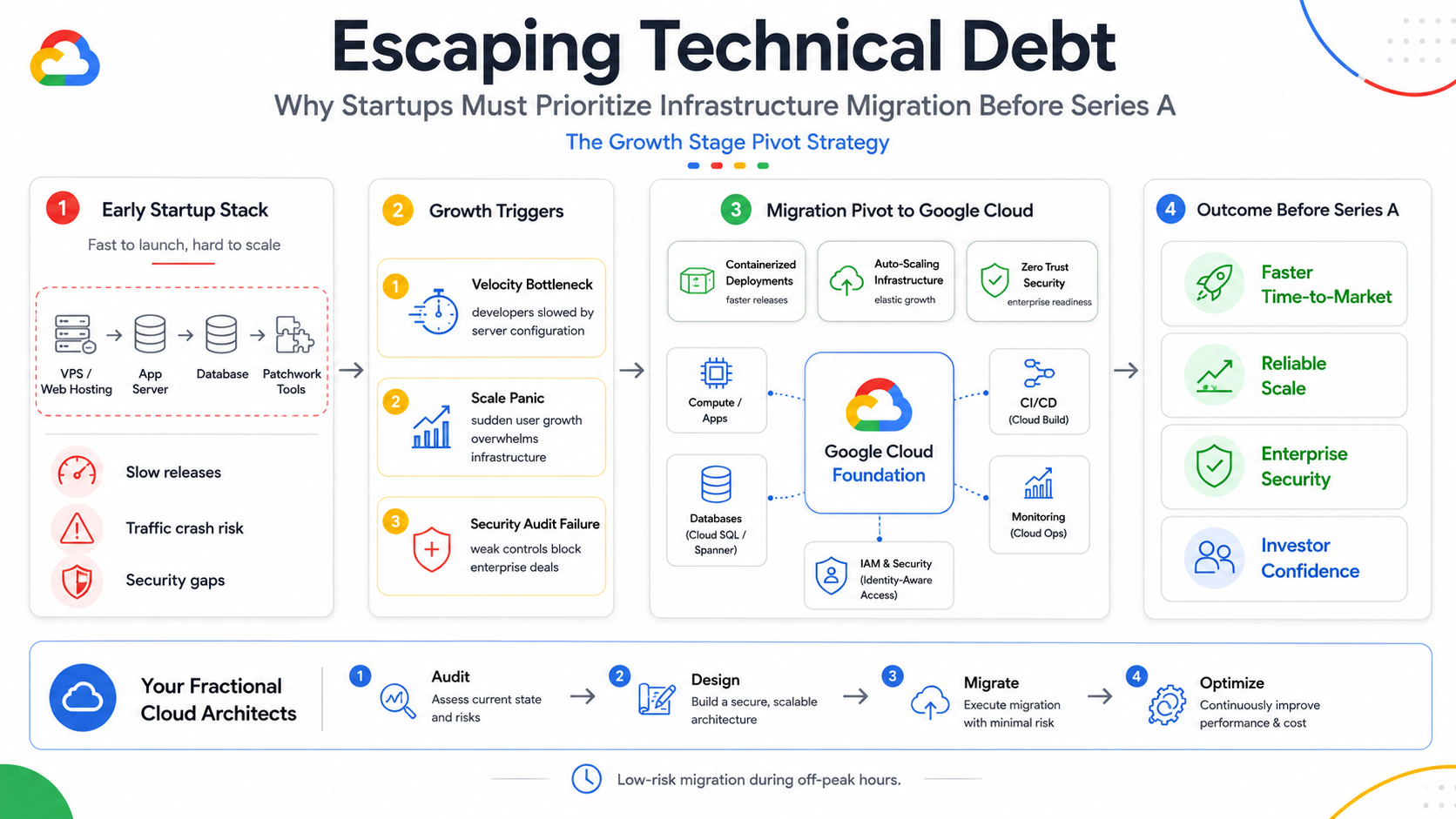
Technical due diligence now derails nearly 60% of early-stage funding deals, and startups that stumble here can see their valuation cut by up to 20% before a term sheet is even signed. For founders heading into Series A, the fastest way to lose investor confidence isn't a rough pitch deck — it's a fragile technology stack held together by the cheapest hosting plan available. Cloud infrastructure migration for startups has become a prerequisite for fundraising, not a nice-to-have, and Google Cloud is where the most fundraise-ready technical teams are landing.
The instinct to bootstrap on basic virtual private servers makes sense in the earliest days — cash is scarce, and shipping fast matters more than architecting for scale. But as your user base grows from hundreds to tens of thousands, those entry-level systems begin to fracture, and the gap between what you have and what a Series A reviewer expects to see only widens.
Evonence is a Google Cloud Premier Partner with over a decade of enterprise migration experience. Here's exactly what changes when you move off legacy hosting and onto Google Cloud before your fundraising timeline forces the issue.
Legacy Hosting vs. Google Cloud: What Changes Before Series A
| Criterion | Legacy Hosting | Google Cloud |
|---|---|---|
| Deployment speed | X Manual server config — hours per release | ✓ Cloud Run + Cloud Build — automated, on-demand releases |
| Traffic spikes | X Manual provisioning, crashes under load | ✓ Compute Engine autoscaling + Cloud Load Balancing — expands in seconds |
| Security posture | X Basic firewall, no formal access controls | ✓ IAM + BeyondCorp Enterprise — Zero Trust, continuous scanning |
| Cost visibility | X Flat fees regardless of usage | ✓ Usage-based billing with granular cost monitoring |
| Audit & diligence readiness | X Fails enterprise security audits and technical due diligence | ✓ Built to pass Series A diligence and ISO 27001-aligned reviews |
Our 3-Phase Migration Strategy (Zero Downtime, Fundraise-Ready)
Phase 1
Infrastructure Audit and Migration Roadmap
We map your current stack against the technical due diligence checklist a Series A reviewer will actually use — architecture, security posture, and accumulated technical debt.
You leave with a prioritized migration roadmap, not a generic cloud sales pitch.
Phase 2
Containerized Migration, Executed Off-Peak
Evonence's Google Cloud-certified architects migrate your application using Cloud Run and Cloud Build, scheduling cutover during your lowest-traffic windows to protect active users.
Autoscaling via Compute Engine and Cloud Load Balancing is configured from day one — not bolted on after your next growth spike.
Phase 3
Zero Trust Security and Compliance Hardening
We implement IAM, BeyondCorp Enterprise, and continuous vulnerability scanning so your infrastructure can withstand both an enterprise buyer's security audit and an investor's technical review.
The result: a fundraising story backed by infrastructure that holds up under scrutiny, not just a slide in the deck.
Still Not Convinced You Need This Before Series A?
These are the three patterns that show up first — usually in support tickets and engineering standups, well before a diligence meeting ever gets scheduled:
The Velocity Bottleneck — deploys take hours instead of minutes because engineers are manually configuring servers instead of shipping code.
The Scale Panic — a single viral moment or big partnership could crash your current infrastructure instead of proving your traction.
The Security Audit Failure — entry-level servers lack the access controls and audit logging an enterprise buyer or Series A reviewer will ask to see.
Why High-Growth Startups Choose Evonence for Google Cloud
Startups rarely have the budget for a full-time, in-house cloud migration architect — and they shouldn't need one. Evonence operates as a seamless extension of your existing engineering team, bringing enterprise-grade Google Cloud expertise without the enterprise-grade headcount.
Frequently Asked Questions
How long does a startup cloud migration to Google Cloud typically take?
Most startup migrations take 4–8 weeks depending on application complexity. We phase the roadmap so the highest-risk services move first, giving you time to prepare your investor narrative before diligence begins.
Can we migrate to Google Cloud without downtime?
Yes. We schedule cutover during your lowest-traffic windows and use containerized deployments via Cloud Run, so active users experience no service interruption during the move.
Do we need to rebuild our application to run on Google Cloud?
In most cases, no. We containerize your existing application with Cloud Run and Cloud Build rather than rewriting it from scratch, which keeps migration timelines short and engineering disruption minimal.
Will migrating to Google Cloud help us pass ISO 27001 or enterprise security audits?
Google Cloud's infrastructure is itself ISO/IEC 27001:2022 certified, and it's built on a Zero Trust model using IAM and BeyondCorp Enterprise. When we configure your access controls and logging correctly, you inherit a security foundation that shortens your own certification timeline — though your organization will still need to complete its own ISO 27001 audit for your specific systems and processes.
Ready to Make Your Infrastructure Series A-Ready?
Schedule a free 30-minute Infrastructure Assessment with one of Evonence's Google Cloud-certified architects. We'll identify your highest-risk technical debt before an investor does — at no cost.