Google Cloud Migration TCO: What On-Prem Infrastructure Really Costs You in 2026
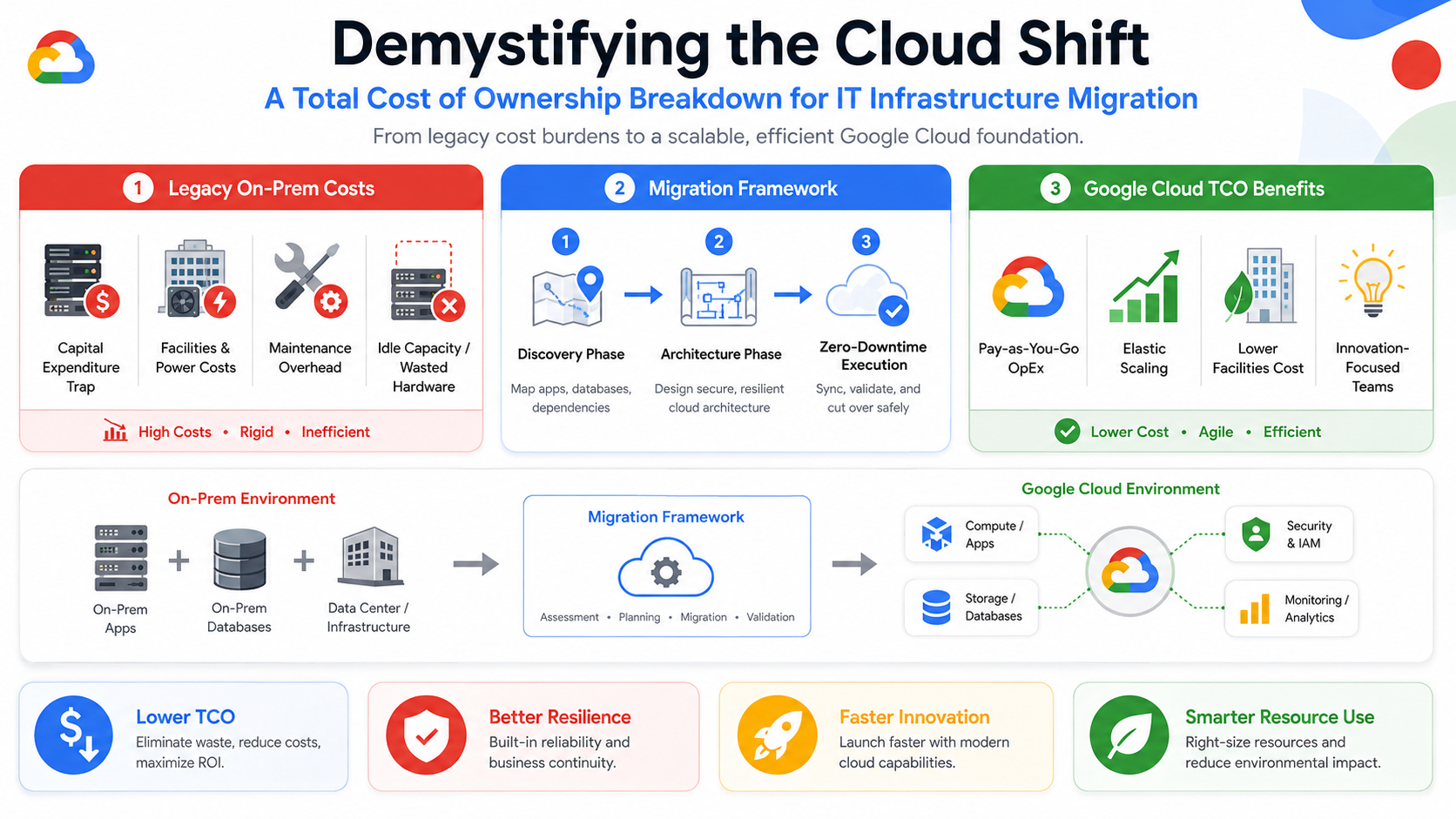
Accenture's research on public cloud adoption found that enterprises moving workloads to the public cloud cut Total Cost of Ownership by 30-40% — yet most CIOs still evaluate a Google Cloud migration by comparing hardware costs to a monthly cloud bill. That comparison misses almost the entire TCO picture.
The real cost of staying on-prem is buried in places finance teams rarely audit: idle servers purchased for peak load that sits unused eleven months a year, industrial cooling and power bills that scale with heat rather than output, and senior engineers spending their week on hardware warranties instead of shipping product. None of that shows up on a line labeled "server costs," but it shows up on every P&L.
Evonence is a Google Cloud Premier Partner with over a decade of enterprise migration experience. We don't just move your infrastructure — we build the TCO model that shows finance exactly where the savings come from, then execute the migration with zero planned downtime.
Google Cloud Migration TCO Audit: 3 Signs Your On-Prem Infrastructure Is Costing You
Before you can build a credible TCO case for Google Cloud, you need to know where your on-prem environment is quietly bleeding budget. These three patterns show up in almost every infrastructure audit we run.
Sign #1: You're paying for capacity you rarely use
Sizing hardware for peak load means most of it sits idle the rest of the year — a textbook Capital Expenditure trap where you pay upfront for capacity that earns nothing on an average Tuesday.
Google Cloud fix: Compute Engine autoscaling, paired with Migrate to Virtual Machines for the initial lift, matches your compute spend to actual demand instead of your worst-case forecast.
Sign #2: Your facilities budget is bigger than your innovation budget
Industrial cooling, fire suppression, and electricity for a private data center are fixed costs that grow every year regardless of how efficiently your applications run.
Google Cloud fix: Google's data centers use AI-driven cooling optimization at a scale no single enterprise can replicate — migrating eliminates your facilities line item entirely.
Sign #3: Your best engineers spend their week on hardware, not on product
Every hour a senior engineer spends patching servers or racking cables is an hour not spent building. Industry benchmarks value a senior engineer's time at roughly $150,000 a year — infrastructure maintenance is an expensive place to park that talent.
Google Cloud fix: Cloud Monitoring and Active Assist recommendations automate the maintenance work, freeing your team for Vertex AI and Gemini-powered product initiatives.
How On-Prem TCO Compares to Google Cloud, Line by Line
A defensible TCO model has to go beyond the compute bill. Here's how the major cost categories compare once you account for the full picture, not just the sticker price.
| Cost Factor | On-Prem Legacy | Google Cloud |
|---|---|---|
| Compute spend model | Capital Expenditure, sized for peak | Operational Expenditure, scales with Compute Engine autoscaling |
| Facilities & power | Cooling, fire suppression, electricity | Eliminated — covered by Google's data centers |
| Engineering time | Patching, racking, warranty management | Shifted to product work via managed infrastructure |
| Hardware refresh cycles | Every 3–5 years, six-figure spend | None — no owned hardware to refresh |
| Cost visibility | Manual, often reactive | Real-time via Cloud Monitoring and Active Assist |
Our 3-Phase Google Cloud Migration Strategy (Zero-Downtime, Cost-Modeled)
A strong financial case still needs flawless execution behind it. A poorly sequenced migration can erase the TCO gains it was supposed to deliver. Here's the framework Evonence's certified architects use on every engagement.
Discovery & TCO Baseline
We deploy automated discovery tooling to map every application, database, and network dependency in your current environment.
Active Assist recommender analysis identifies rightsizing opportunities before a single workload moves, so your TCO baseline reflects reality, not guesswork.
Architecture & Rightsizing
We architect a Google Cloud environment built on Compute Engine autoscaling and Migrate to Virtual Machines — not a like-for-like copy of your on-prem sprawl.
Cloud Monitoring is configured from day one, giving your team real-time cost and performance visibility instead of a monthly surprise.
Zero-Downtime Cutover & Ongoing Optimization
We synchronize data in the background and rigorously test the new environment, only cutting over live traffic once stability is proven.
Post-migration, we track spend against your TCO model using Cloud Billing reports, closing the gap between projected and realized savings.
Why Information Technology Leaders Choose Evonence for Google Cloud
Evonence has been a Google Cloud Premier Partner since 2014, with over 200 GCP projects delivered across Information Technology, FinTech, Retail, and Healthcare. Our architects model the TCO case before proposing the architecture — so the business case survives finance review, not just the technical one.
Frequently Asked Questions
How long does a Google Cloud migration typically take?
For a mid-sized enterprise environment, a well-scoped migration runs 3-6 months from discovery to cutover, with 8+ months typical for large, multi-application portfolios. Evonence's Discovery Phase sets a realistic timeline before any commitments are made.
Can we migrate to Google Cloud without downtime?
Yes. Evonence uses background data synchronization to run your existing and new environments in parallel, testing thoroughly and cutting over live traffic only once the Google Cloud environment matches or exceeds current performance.
How does Google Cloud's autoscaling actually lower TCO compared to on-prem hardware?
On-prem hardware is sized for your highest expected traffic, so it sits idle most of the year. Compute Engine autoscaling expands and contracts with real demand, so you stop paying for capacity you aren't using — this is the single largest driver of the CapEx-to-OpEx savings enterprises report.
Does migrating to Google Cloud affect our ISO 27001 compliance?
Google Cloud's infrastructure holds ISO 27001 certification, and Evonence's architecture phase incorporates your existing compliance controls and audit requirements into the migration plan so certification carries forward without gaps.
Ready to See Your Real Google Cloud Migration TCO?
Schedule a free 30-minute Infrastructure Assessment with one of Evonence's Google Cloud-certified architects. We'll model your on-prem vs. Google Cloud TCO and identify your highest-ROI migration path — at no cost.