Gemini Enterprise for Healthcare: The Cure for Data Chaos?
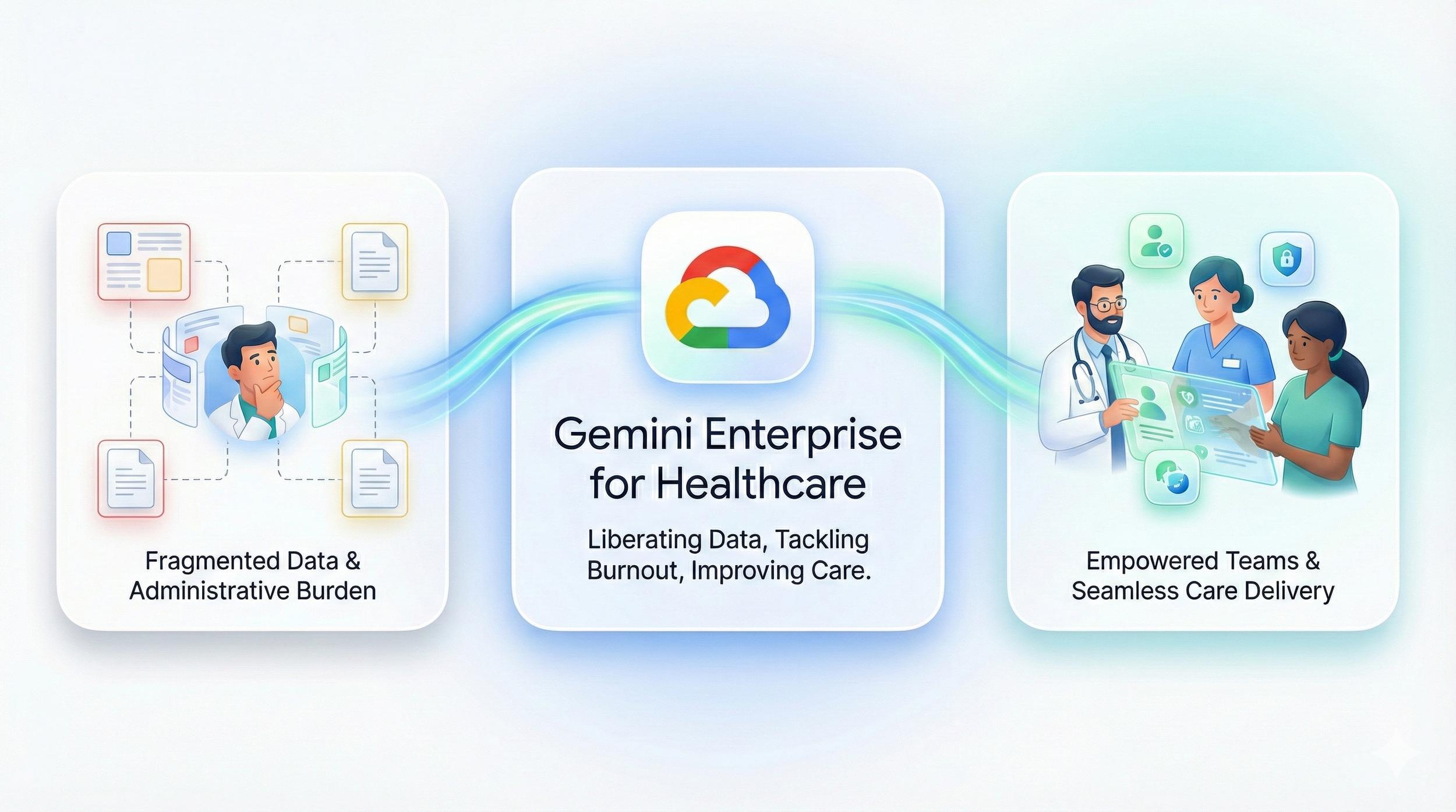
The North American healthcare landscape is operating under unsustainable pressure. Organizations are simultaneously facing a severe clinician shortage, an explosion of healthcare data that remains largely inaccessible, and financial models squeezed by rising costs and evolving reimbursement structures.
While digitalization via Electronic Health Records (EHRs) was meant to drive efficiency, it has inadvertently created a crisis of administrative burden. Physicians and nurses now spend nearly two hours on documentation for every hour spent on direct patient care, leading to record levels of burnout and an exodus from the profession.
Traditional IT approaches, more point solutions, more dashboards, and more rigid workflows within legacy EHRs, are no longer the answer. They are part of the problem. To move forward, healthcare leaders need technology that can reason across complex, fragmented data and automate the cognitively demanding administrative tasks that clog the system. They need intelligent systems that understand medical context, respect privacy boundaries, and actively assist care teams rather than just record their actions.
This is the promise of Gemini Enterprise on Google Cloud. It is not merely another "AI tool" to pilot; it is a secure, multimodal reasoning engine designed to build enterprise-grade AI agents. These agents can operate across your existing infrastructure, EHRs, PACS, payer portals, and productivity suites, to liberate data and automate workflows. At Evonence, as a Premier Google Cloud Partner specializing in health data and Gen AI, we help organizations move beyond the hype to deploy trusted, HIPAA-aligned Gemini solutions that bring tangible relief to the frontline.
The Structural Challenges Paralyzing Healthcare
Before discussing solutions, we must acknowledge the deeply entrenched friction points that CIOs and clinical leaders are battling daily. The challenge isn't a lack of data; it's a lack of actionable synthesis.
1. The Administrative Crisis and Clinician Burnout
The modern EHR has turned clinicians into data entry clerks. The cognitive load of navigating dozens of tabs, clicking through mandatory fields, and drafting extensive notes after hours is unsustainable. This administrative friction is the primary driver of burnout, directly impacting staffing ratios, patient access, and the quality of care.
2. The Interoperability and Data Silo Paradox
Despite decades of effort and regulation (like the 21st Century Cures Act), a true "longitudinal patient record" remains elusive for most organizations. Crucial patient data is trapped in silos: unstructured clinician notes, PDFs from external labs, DICOM images in PACS, and claims data in finance systems.
Clinicians often make decisions based on incomplete information because assembling the full picture takes too long.
3. Operational Friction (The "Prior Auth" Problem)
Processes between providers and payers remain shockingly manual. Prior authorization, claims processing, and eligibility checks often involve fax machines, phone calls, and manual review of medical policies against patient charts. This creates massive administrative overhead and delays patient access to necessary treatments.
4. Rising Patient Expectations vs. System Capacity
Patients expect the same digital seamlessness in healthcare that they experience in retail or banking, instant scheduling, clear answers to medical questions, and easy navigation of care plans. However, overworked staff and rigid portal technology mean the patient experience is often frustrating and disjointed.
Defining Gemini Enterprise for Healthcare Leaders
For the healthcare executive, it is crucial to distinguish Gemini Enterprise from consumer-grade chatbots. Gemini Enterprise is a secure, enterprise-grade platform on Google Cloud designed for building intelligent agents that can reason and act within highly regulated environments.
Why it is different for healthcare:
Multimodal Understanding: Medicine is not just text. Gemini can process and reason across diverse data types simultaneously, analyzing clinical notes (text), interpreting X-rays or MRIs (images), and listening to patient consultations (audio), to form a complete picture.
Grounded Accuracy (RAG): In healthcare, hallucination is unacceptable. We use Retrieval-Augmented Generation (RAG) to ensure Gemini’s responses are "grounded" solely in your trusted enterprise data, your clinical guidelines, your patient records, and your approved protocols, not general internet data.
Enterprise Security & Compliance: Gemini Enterprise operates under Google Cloud’s robust security framework. Your data is not used to train Google’s foundational models. The platform supports HIPAA compliance and offers the necessary controls for data residency and access governance, covered under a Business Associate Agreement (BAA).
Workflow Integration: It is not a standalone destination. Gemini agents can be embedded directly into the tools staff use daily, such as Google Workspace (Docs, Gmail, Meet) or integrated via APIs into core EHR platforms (Epic, Cerner, Meditech).
High-Impact Use Cases for Healthcare Operations
At Evonence, we focus on deploying Gemini Enterprise where it can alleviate the most significant pressure points: clinical documentation burden, operational bottlenecks, and patient navigation.
1. Ambient Clinical Intelligence (The "Scribe" Agent)
The Problem: A primary care physician spends 15 minutes with a patient and another 20 minutes documenting the visit in the EHR after hours. This is the primary engine of burnout. The Gemini
Solution: We deploy an ambient listening agent in the exam room (via mobile or dedicated device). The agent listens to the physician-patient dialogue in real-time, filters out small talk, captures medical relevance, and automatically drafts a structured SOAP note (Subjective, Objective, Assessment, Plan) mapped to the correct EHR fields.
Outcomes:
Significant reduction in "after hours" documentation.
Engineers are more focused on patient-provider interactions as the physician isn't staring at a screen.
Faster note closure, accelerating billing cycles.
2. Automated Prior Authorization Triage
The Problem: A hospital's revenue cycle team employs dozens of staff whose primary job is to read clinical charts, find supporting evidence for a procedure, cross-reference it with a payer’s 50-page policy PDF, and submit a request form.
The Gemini Solution: A multimodal agent is tasked with this workflow. The agent ingests the patient’s medical record (structured data and unstructured notes) and the payer’s specific policy document for the requested procedure. It then reasons across both documents to determine if criteria are met, highlights the supporting evidence in the chart, and even drafts the submission letter for human review.
Outcomes:
Drastic reduction in administrative man-hours per authorization.
Decreased denial rates due to more accurate, evidence-backed submissions.
Faster time-to-treatment for patients.
3. Intelligent Patient Care Navigator
The Problem: Patients discharged after complex surgeries are often overwhelmed with paper instructions. When they have questions post-discharge, they call the clinic, waiting on hold while staff scramble to find their file.
The Gemini Solution: A secure, patient-facing generative agent embedded in the patient portal. Grounded strictly in the patient's specific discharge summary and the hospital’s approved clinical education materials, the agent can answer questions like, "Is this level of swelling normal for Day 3 after my knee replacement?" or "Remind me which medication I take with food."
Outcomes:
Improved patient adherence to care plans and reduced readmissions.
Reduction in low-complexity inbound calls to nursing staff.
24/7 support availability for patients.
4. Multimodal Imaging Workflow Optimization
The Problem: Radiologists are facing immense volume pressures. Triaging worklists to prioritize acute cases often relies on limited ordering information from referring physicians.
The Gemini Solution: A multimodal agent that analyzes the incoming image (e.g., a chest CT) alongside the patient’s recent electronic health history. The agent can flag potential critical findings on the scan (like a possible pulmonary embolism) and summarize relevant context from the notes (e.g., "Patient has recent history of DVT and sudden onset shortness of breath"), pushing this case to the top of the radiologist’s worklist.
Outcomes:
Faster turnaround times for critical diagnoses.
Reduced cognitive load for radiologists by providing synthesized context instantly.
5. Clinical Trial Cohort Identification
The Problem: Research coordinators spend weeks manually reviewing charts to find patients who match complex inclusion/exclusion criteria for clinical trials, often missing eligible candidates buried in unstructured notes.
The Gemini Solution: An agent grounded in the research institution's data lake (built on BigQuery). Researchers can use natural language queries, such as: "Identify female patients over 50 with a diagnosis of Type 2 Diabetes in the last 3 years, an A1c over 8, who are not currently on insulin, and mention 'neuropathy' in their clinical notes." Gemini parses the structured criteria and unstructured text to generate a candidate list.
Outcomes:
Accelerated clinical trial recruitment from months to days.
More accurate feasibility analysis for proposed studies.
Architecture & Trust – Grounding AI in Healthcare Data
In healthcare, architecture is the strategy. If the data isn't secure, governed, and interoperable, the AI is useless. Evonence leverages the power of Google Cloud to build a trusted foundation for Gemini.
The Unified Data Foundation (BigQuery & Healthcare API)
Before an agent can act, it needs access to data. We utilize Google Cloud's Healthcare Data Engine and BigQuery to create a longitudinal record.
We ingest data from EHRs using industry standards like HL7v2 and FHIR capabilities within Google Cloud’s Healthcare API.
We harmonize structured data, unstructured notes, and even imaging metadata into BigQuery, creating a single source of truth that Gemini can reason over.
Grounding and Governance (Vertex AI)
We use Vertex AI to manage the interaction between Gemini and your data.
RAG (Retrieval-Augmented Generation): We configure the system so that every answer Gemini provides is traced back to a specific source document in your environment, allowing clinicians to verify the information (the "human-in-the-loop" model).
Access Controls: We utilize rigorous Identity and Access Management (IAM). An agent designed for revenue cycle staff will not have access to highly sensitive psychotherapy notes, for example.
Security and Compliance
Security is non-negotiable.
HIPAA Alignment: Google Cloud supports HIPAA compliance, and Evonence ensures that implementations are covered under the necessary Business Associate Agreements (BAAs).
Data Residency: We ensure data processing and storage adhere to US or Canadian data residency requirements.
Privacy Preservation: Your patient data is isolated in your project and is never used to improve Google's public models.
Change Management & Adoption in Clinical Settings
Healthcare is risk-averse for good reason; patient safety is paramount. Introducing Gen AI requires a culture-first approach, not a technology-first push.
The Evonence Adoption Framework:
Clinical Governance First: Before a single line of code is written, we help establish an AI Governance Council comprising clinical leaders (CMO/CMIO), legal, ethics, and IT. They define the guardrails and approve use cases.
Augmentation, Not Automation: We position Gemini agents as "assistants" to the care team. The AI provides a draft note, a suggested authorization packet, or a triaged image, but a qualified human always makes the final clinical or operational decision.
Pilot and Validate: We start with narrow, measurable pilots (e.g., ambient documentation for five orthopedic surgeons). We measure impact on time, accuracy, and satisfaction before scaling across a department.
Training for Trust: User training focuses not just on how to use the tool, but on understanding its limitations, knowing when to trust the AI's draft and when to intervene.
Why Evonence + Google Cloud for Healthcare
Successfully navigating the intersection of complex healthcare data standards (FHIR, HL7, DICOM), strict regulatory environments (HIPAA/PHIPA), and cutting-edge generative AI requires a specialized partner.
Evonence is a Premier Google Cloud Partner with deep expertise in the healthcare vertical across the US and Canada.
Our Healthcare Superpower: Connecting the Dots
We don't just build models. We understand the end-to-end workflow.
Data Readiness: We know how to unlock data from legacy EHRs and harmonize it in Google's Data Cloud so it's ready for AI.
Gen AI Specialization: We have proven expertise in configuring Gemini Enterprise, designing effective prompts for medical contexts, and implementing RAG architectures for grounded accuracy.
Work Transformation: We understand that healthcare runs on communication. We seamlessly integrate Gemini agents into Google Workspace, meeting clinical and administrative staff where they already work.
From initial strategy and data architecture design to building compliant agents and managing organizational change, Evonence is the partner that turns the promise of healthcare AI into operational reality.
Conclusion
The healthcare industry is at an inflection point. The current path of increasing administrative burden and fragmented data is unsustainable for clinicians and patients alike.
Gemini Enterprise offers a pragmatic, secure path forward. By deploying intelligent agents that can reason across your data and assist your workforce, you can begin to reverse the trends of burnout and inefficiency. The technology is ready; the challenge now is execution with trust and governance.
It’s time to move from experimenting with AI to operationalizing it for the sake of your care teams and your patients.
Take the Next Step
[Book a 60-Minute "Art of the Possible" Workshop]
Gather your clinical and IT leadership for an interactive session on how peer organizations are safely deploying AI agents today.