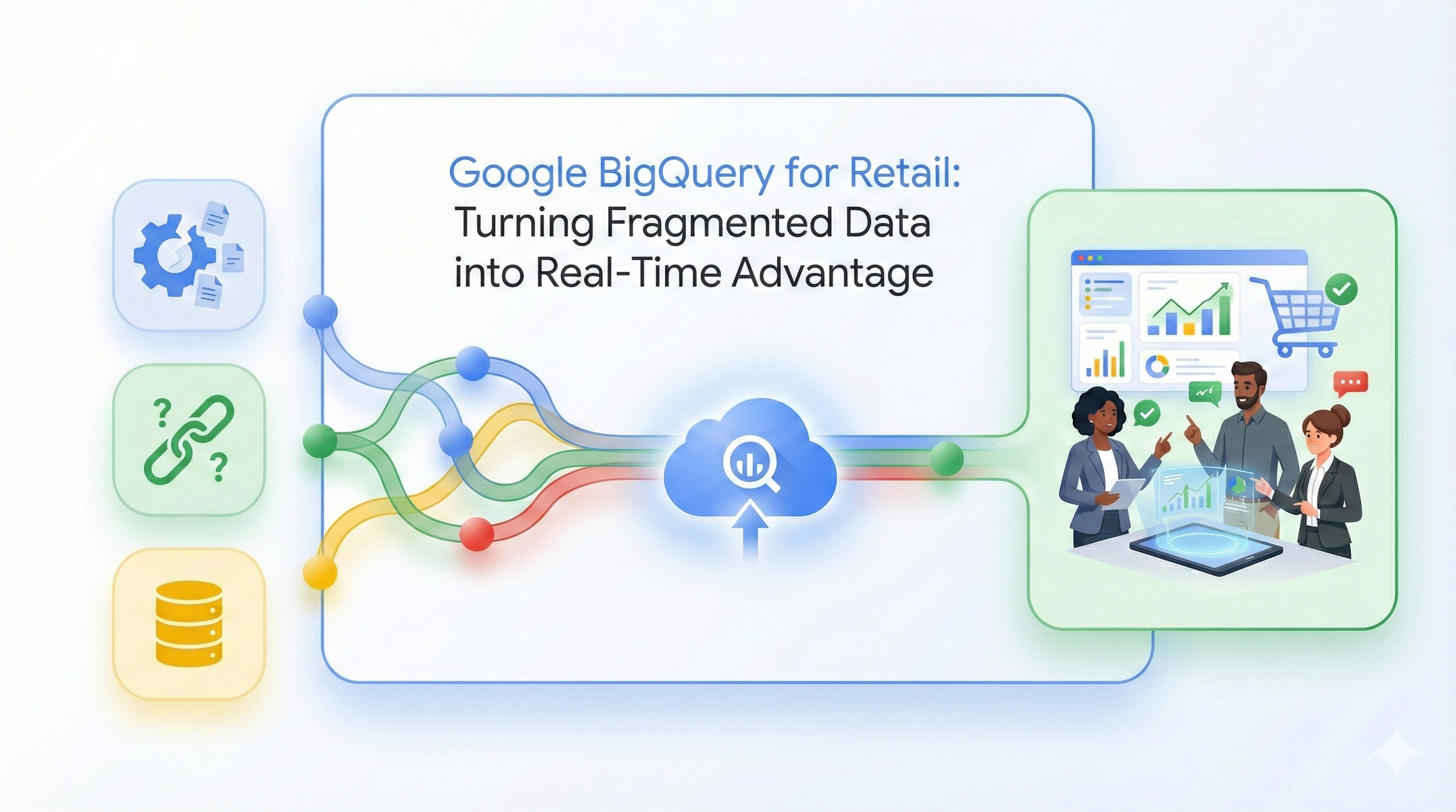
Google BigQuery for Retail: Turning Fragmented Data into Real-Time Advantage
The Monday Morning "Rearview Mirror"
Imagine it is 9:00 AM on a Monday. You are the VP of Merchandising or perhaps the Head of Digital for a mid-to-large-sized retailer. You sit down for the weekly trading meeting, coffee in hand, ready to review the weekend’s performance. The spreadsheets are open. The dashboards are projected.
But there is a problem: the numbers you are looking at are already ghosts.
They represent what happened up until midnight Sunday. They don't account for the returns processed this morning, the sudden spike in social media traffic on your new product launch an hour ago, or the inventory discrepancy currently grounding shipments at your West Coast distribution center. You are effectively steering a massive ship by looking exclusively in the rearview mirror.
In the current retail landscape, where trends are born on TikTok in minutes and supply chains are disrupted by weather events in hours, this latency is a margin killer. You are making discounting decisions based on inventory data that might be wrong, and you are deploying marketing spend based on customer segments that haven't been updated since last week’s batch job.
The push to deliver a consistent phygital experience is exposing the limits of legacy systems. Point-of-sale data sits in isolated store systems, e-commerce platforms operate independently in the cloud, and logistics data remains locked inside monolithic ERPs.
This is a common pattern Evonence sees across multi-store and omnichannel retailers that still rely on weekly, batch-based reporting.
At this stage, incremental fixes no longer help. The focus needs to shift from stitching together spreadsheets to establishing a single source of truth. Google BigQuery provides that foundation, both as a centralized data store and as the engine that converts fragmented retail data into a real-time, actionable advantage.
The High Cost of Fragmentation in Retail
Before we discuss the technology, we must acknowledge the specific data dysfunctions that plague modern retail operations. Most retailers aren't struggling because they lack data; they are struggling because they cannot see the picture the data is trying to paint.
The "Omnichannel Mirage"
Customers expect to buy online, pick up in-store (BOPIS), or buy in-store and ship to home. However, for many retailers, the E-commerce customer ID and the in-store transaction history never meet. Marketing teams send "We miss you!" emails to customers who bought a coat in-store yesterday because the online system thinks they haven't shopped in three months. This fragmentation degrades the customer experience (CX) and wastes ad spend.
The Inventory Black Hole
Inventory visibility is often the biggest casualty of siloed data. The Warehouse Management System (WMS) updates the ERP, which eventually updates the E-commerce storefront via a scheduled batch process. That 4-hour (or 24-hour) lag leads to overselling, where a customer buys an item online that physically doesn't exist. The result is a cancelled order, a furious customer, and operational cost to process the refund.
Promotion Blindness
Retailers run thousands of promotions simultaneously. But measuring the true profitability (ROI) of a specific campaign usually requires marrying ad spend data (from Google/Meta) with transactional margin data (from the ERP). In a fragmented environment, this reconciliation happens manually in Excel, weeks after the promo has ended. You cannot pivot a failing campaign in real-time if you don’t know it’s failing until next month.
The "Guest User" Abyss
A significant percentage of retail transactions are "guest checkouts" or cash purchases. In legacy systems, these are treated as anonymous, one-off events. Valuable data regarding basket composition, regional preferences, and price sensitivity is lost because the system cannot link these "ghost" transactions to broader demographic patterns or probabilistic profiles.
Recommended Read: Why Every Retailer Needs to Know About Gemini Enterprise
What BigQuery Actually Changes?
For the Executive leader, strip away the technical jargon of "serverless architecture" or "SQL compliance." Here is what Google BigQuery actually represents for a retail business:
It is a Central Nervous System
BigQuery acts as the single destination where all data lands. It ingests the streaming "clicks" from your website, the transactional "ticks" from your POS, and the logistical "pings" from your supply chain sensors. It handles this scale effortlessly, separating the storage of data from the computing power needed to analyze it. This means you can keep petabytes of historical data for trend analysis without slowing down the query you need to run right now.
It Eliminates the "Wait for the Batch"
Traditional data warehouses rely on overnight extraction, transformation, and loading (ETL). By the time you get the report, the data is stale. BigQuery supports streaming ingestion. This means a sale made in Toronto can influence a demand forecast model in New York within seconds, not days.
It is the Foundation for Gen AI
You cannot build sophisticated AI, like generative styling assistants or predictive supply chain bots, on messy data. BigQuery is the native data foundation for Google Cloud’s Gemini. It allows you to run machine learning models directly where the data lives (BigQuery ML) without moving data around, reducing security risks and complexity.
It Democratizes Answers
Instead of the C-suite relying on a bottlenecked IT team to write SQL queries for every question, BigQuery connects seamlessly to visualization tools like Looker. This empowers a Merchandising Manager to drill down into "Sales by Region by SKU" independently, fostering a culture of self-service intelligence.
Retail Use Cases – Turning Data into Dollars
How does this infrastructure translate to the P&L? Here are four distinct scenarios where BigQuery changes the game for retailers.
1. Dynamic Markdown Optimization
The Situation: A fashion retailer has 50,000 units of seasonal outerwear. The season is ending, and they need to clear stock without destroying margins.
Data in Play: Historical sales curves, current inventory levels per store, local weather forecasts, and competitor pricing signals.
What BigQuery Enables: Instead of a blanket "30% off" nationwide, BigQuery ML models analyze elasticity at a granular level. The system might recommend a 20% discount in Chicago (where it’s snowing) but a 40% discount in Atlanta (where it’s warming up).
The Impact: Margin preservation. The retailer clears inventory at the highest possible price point for each specific market, maximizing revenue recovery.
2. The "360-Degree" Customer Profile
The Situation: A luxury home goods brand wants to increase Customer Lifetime Value (CLV) but struggles to connect online browsing with showroom visits.
Data in Play: Website clickstream (Google Analytics 4), CRM data (Salesforce/HubSpot), POS transaction logs, and Customer Service tickets.
What BigQuery Enables: By unifying these sources, BigQuery creates a "Golden Record" for each customer. When a client walks into a showroom, a sales associate’s tablet can display that this customer spent 20 minutes looking at leather sofas online last night and had a shipping issue three years ago that was resolved.
The Impact: Hyper-personalized service that drives higher conversion rates and repairs loyalty. The customer feels "known," not processed.
3. Supply Chain "Control Tower" Visibility
The Situation: A global electronics retailer relies on components shipping from APAC. A port strike delays shipments, threatening Black Friday stock levels.
Data in Play: ERP purchase orders, 3rd-party logistics (3PL) status feeds, shipping container GPS APIs, and supplier production schedules.
What BigQuery Enables: A real-time dashboard (via Looker) that flags "At Risk" SKUs immediately. It allows the operations team to simulate scenarios: "If we air-freight 10% of stock, what is the cost vs. the lost revenue of being out-of-stock?"
The Impact: Agility. The business pivots logistics strategies weeks before the shortage hits the shelves, protecting revenue and customer trust.
4. Real-Time Fraud Detection
The Situation: Cyber Week brings a massive spike in traffic, providing cover for bot attacks and credit card fraud.
Data in Play: Real-time transaction streams, IP geolocation, device fingerprinting, and historical chargeback data.
What BigQuery Enables: Using BigQuery ML, the retailer scores every transaction in milliseconds against fraud probability models. Suspicious patterns (e.g., 50 orders from one IP address in 1 minute) trigger an immediate block or manual review flag before the goods leave the warehouse.
The Impact: massive reduction in chargebacks and inventory shrinkage, without adding friction for legitimate customers.
Recommended Read: Using BigQuery + Dataflow to Forecast Demand and Manage Seasonal Peaks
High-Level Architecture – BigQuery as the Hub
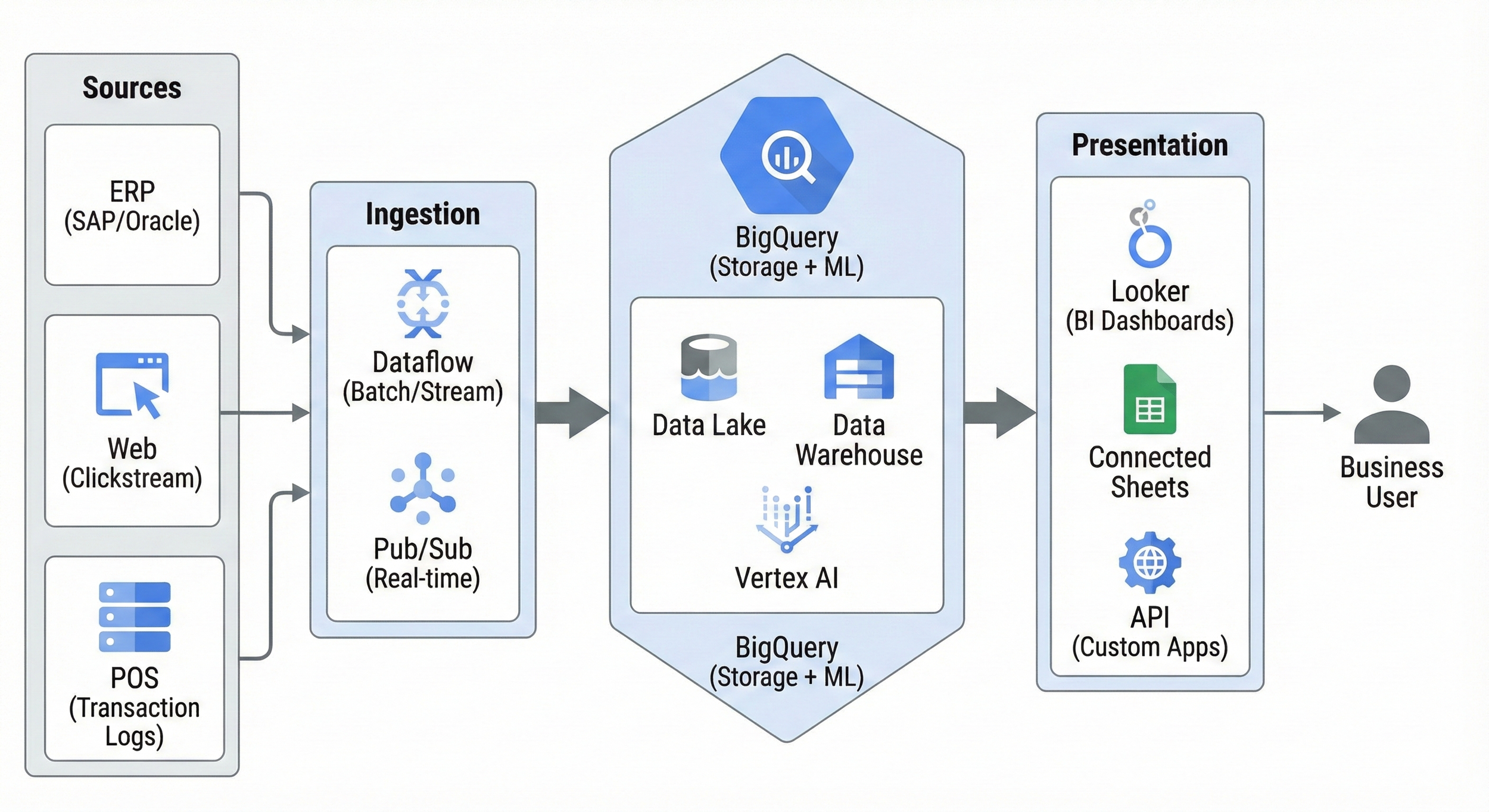
For the CTO and Head of Data, the architecture isn't about replacing everything you have; it's about connecting it. BigQuery serves as the "Hub" that decouples your data speed from your legacy system limitations.
The Flow of Intelligence:
Ingest (The Feed):
Batch Data: Nightly loads from SAP, Oracle, or Microsoft SQL Server via connectors.
Streaming Data: Real-time events (website clicks, IoT sensors) flow in via Dataflow or Pub/Sub.
Zero-ETL: Direct federation from sources like Google Spanner or Cloud SQL.
Store & Model (The Brain):
Data lands in BigQuery.
Raw data is kept in a "Data Lake" layer.
modeled, clean data is transformed into a "Data Warehouse" layer using dbt or Dataform.
Vertex AI accesses this data directly to train models.
Consume (The Action):
Looker: For BI dashboards and metric governance.
Connected Sheets: For finance teams who love Excel/Sheets but need live data.
Reverse ETL: Pushing segments back into marketing platforms (Google Ads, Facebook) or CRMs.
The Architecture at a Glance:
From Quick Wins to Data Strategy
Moving to a Data Cloud is a journey, but it doesn't have to be a multi-year "rip and replace." We recommend a phased approach:
Phase 1: The Lighthouse Project (Weeks 1-8): Identify one high-value pain point—perhaps the "Inventory Visibility" issue. We set up BigQuery, ingest just the necessary inventory and sales data, and build a real-time dashboard. This proves value quickly and wins executive buy-in.
Phase 2: The Foundation (Months 3-6). Establish data governance. Define what "Net Sales" actually means across the organization. Build the core data pipelines from your major ERP and CRM systems.
Phase 3: The Innovation Layer (Month 6+). This is where AI comes in. With clean data in place, we deploy Gemini for predictive forecasting, personalized recommendation engines, and conversational analytics.
Why Evonence + Google Cloud?
Technology is only as good as the strategy behind it. BigQuery provides the engine, and Evonence provides the navigation.
As a Premier Google Cloud Partner, Evonence specializes in the "Art of the Possible" for retail data. We don't just lift and shift your servers; we transform your workflows.
Deep BigQuery Expertise: We know how to optimize queries to keep costs low and performance high.
Work Transformation: We bridge the gap between data teams and business users, integrating insights directly into Google Workspace (Sheets, Slides, Docs).
Gen AI Readiness: We are at the forefront of deploying Gemini Enterprise solutions, helping you move from "reporting" to "predicting."
We understand that in retail, you are only as good as your last season. We help you build the infrastructure to win the next one.
The New Retail Reality
The era of intuitive retailing is over. The winners of the next decade won't be the ones with the best gut instincts; they will be the ones with the fastest data.
BigQuery offers the scalability to handle your Black Friday peaks and the intelligence to optimize your random Tuesday slumps. It turns the noise of fragmented systems into a clear signal for decision-making.
Are you ready to see what your data is actually telling you?
Next Steps
Don't let another quarter pass looking in the rearview mirror.
Book a "Data Cloud Discovery" Workshop: Let’s map your current data silos and identify your highest-ROI use cases.
Request a Readiness Assessment: Our team will review your current infrastructure and provide a roadmap to a modern, AI-ready Data Cloud.