Google BigQuery for Financial Services: The Power of Real-Time Risk Intelligence
The Quarter-End Reconciliation Fire Drill
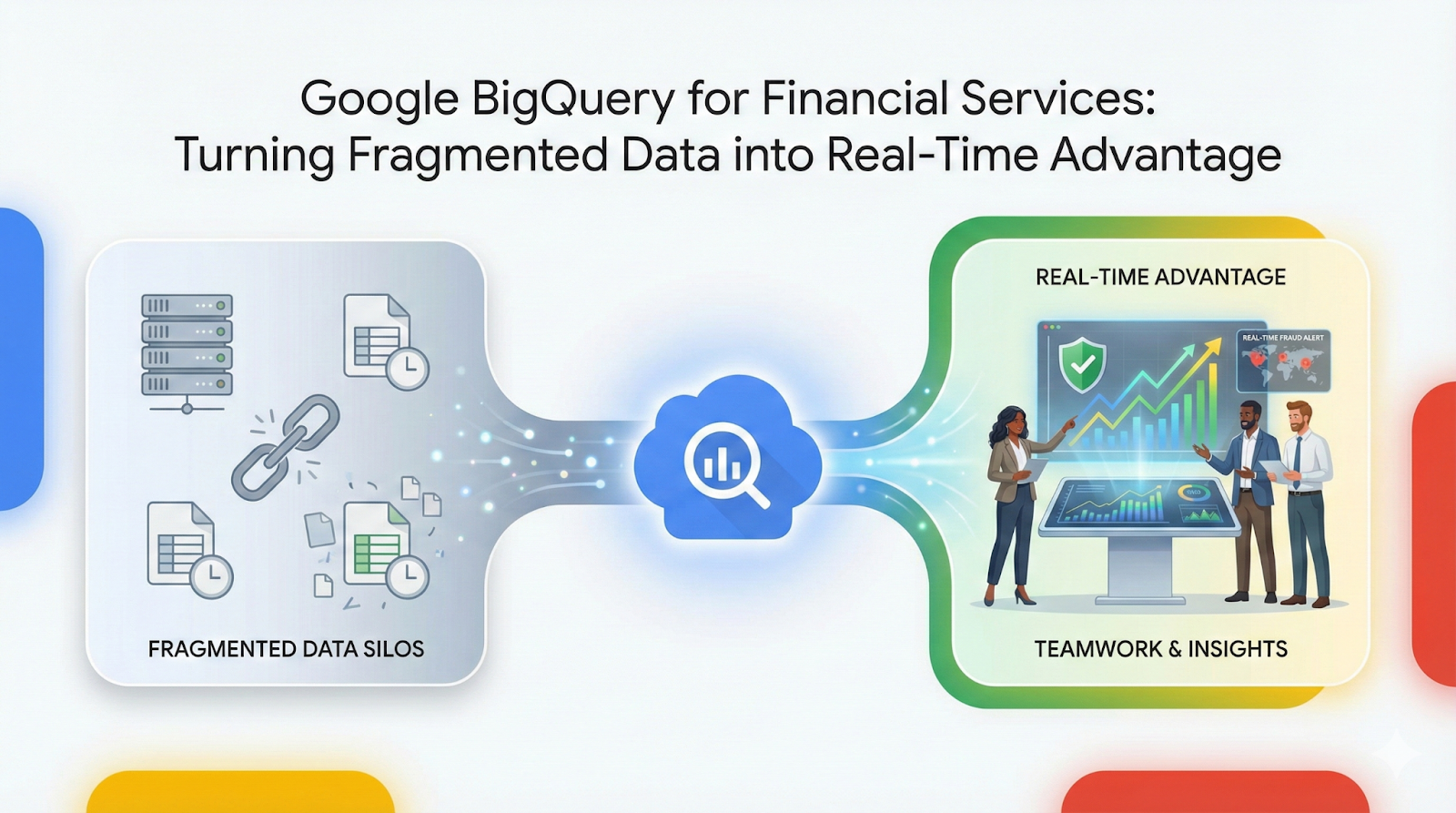
The Quarter-End Reconciliation Fire Drill It is a scenario familiar to almost every COO or Chief Data Officer in financial services. It’s 4:00 PM on the Friday before a major regulatory submission deadline, perhaps for CCAR in the US or an OSFI request in Canada. The Executive Committee needs a consolidated view of liquidity risk exposure across retail banking, commercial lending, and capital markets divisions.
In theory, this should be a dashboard refresh. In reality, it is a weekend-long fire drill.
Your teams are currently downloading massive CSV dumps from a 30-year-old mainframe core banking system. They are desperately trying to map that data against spreadsheets from the mortgage division and contrasting it with near real-time feeds from the trading desk. Data lineage is non-existent. "Version control" means emailing files named Final_Report_V12_ACTUAL_FINAL.xlsx back and forth.
By the time the report is stitched together on Monday morning, the risk landscape has already shifted. You aren't managing risk; you are archaeologically reconstructing it.
This scenario reflects what Evonence regularly sees across banks, insurers, and capital markets firms preparing for CCAR, IFRS 17, liquidity stress tests, and ad-hoc regulatory requests.
Financial institutions today are data-rich but insight-poor. They possess petabytes of high-value transactional history, but it is trapped in rigid silos, legacy cores, disparate loan origination systems, and acquired fintech platforms that never truly integrated. This fragmentation slows down innovation, frustrates customers who expect seamless digital experiences, and, most critically, hides risk patterns until it’s too late to react.
The shift required isn't just about buying faster storage; it's about changing the fundamental architecture of how financial data is ingested, governed, and acted upon. This is where Google BigQuery enters the conversation, not merely as a data warehouse, but as the compliant, scalable foundation for a real-time financial enterprise.
The Unique Data Burdens of Financial Services
While every industry struggles with silos, the stakes in financial services make data fragmentation an existential threat. The pressure comes from multiple, opposing directions.
The Legacy Core Anchor
Most established banks and insurers still run their most critical operations, deposits, policy administration, general ledger, on mainframe technology dating back decades. These systems are incredibly robust for transaction processing but are hostile to modern analytics. Getting data out for analysis often involves expensive MIPS charges, complex change data capture (CDC) processes, or overnight batch jobs that guarantee your intelligence is always at least a day old.
The Regulatory Treadmill
Regulatory requirements such as Basel, Dodd-Frank, IFRS 17, and regional privacy mandates require granular, reconciled data with defensible lineage, controls, and audit trails, not just final numbers. Regulators no longer just want the final number; they want to know how you arrived at it. When data crosses five different systems before reaching a report, proving that lineage during an audit is a manual, error-prone nightmare.
The Fragmented Customer View
A client might have a business loan, personal checking accounts, and a wealth management portfolio with the same institution. Yet, because these products live on separate sub-ledgers, the bank sees three different customers. This makes it impossible to assess total relationship risk accurately or to offer proactive, personalized financial advice. The customer feels treated like a number, increasing churn to digital-first competitors.
The "Hidden Signal" Problem
Fraudsters and market risks move fast. Often, the signal for a sophisticated bust-out fraud scheme or a sudden liquidity crunch isn't in one dataset, it's hidden in the correlation between web server logs, transaction speed, and external market data signals. If these datasets reside in disconnected environments, you cannot connect the dots in time to stop the bleeding.
Why Does This Matters Now for Financial Services Leaders?
As a Premier Google Cloud Partner, Evonence works with financial institutions modernizing risk, finance, and regulatory data estates while operating under strict compliance, audit, and security constraints. The patterns below are drawn from real-world engagements involving legacy core banking platforms, fragmented regulatory reporting stacks, and growing pressure for intraday risk visibility.
What BigQuery Actually Changes?
For financial leadership, shifting to Google BigQuery isn't an IT infrastructure upgrade; it's a strategic maneuver to regain agility. Here is what it changes in practical terms:
1. The "Serverless" Ledger
Traditional data warehouses require you to provision hardware for your peak usage (e.g., Black Friday or end-of-month processing). You pay for that capacity even when you aren't using it. BigQuery is serverless. It completely separates storage from compute. You can store petabytes of historical tick data cheaply, and then spin up massive computing power instantly to run a complex risk model, paying only for the seconds the query runs. This elasticity is crucial for the variable workloads of finance.
2. Moving from Batch to Streaming
Financial markets don't wait for overnight batch jobs. BigQuery is designed to handle high-velocity streaming data alongside historical batch data. This means a transaction happening at a POS terminal, a tick on a trading desk, and a click on your mobile app can all land in the same analytics environment within seconds, enabling intraday decision-making.
3. Governance & Security Built-In
In finance, you cannot democratize data without locking it down. BigQuery operates within Google Cloud's robust security model, offering default encryption and granular identity and access management (IAM). Crucially, it supports column-level security, meaning you can allow a data scientist to analyze mortgage trends without ever exposing the Personally Identifiable Information (PII) in the "Social Security Number" column.
This allows financial institutions to enforce separation of duties, apply data loss prevention (DLP) policies to sensitive fields, and maintain auditable access logs, capabilities that are essential for regulators, internal audit, and risk committees.
4. The AI Foundation (Gemini Ready)
Financial institutions are racing to deploy generative AI for everything from code modernization to conversational client assistants. But AI models like Google’s Gemini are useless without clean, accessible ground truth. BigQuery acts as that unified ground truth, allowing you to bring the model to the data (via BigQuery ML and Vertex AI) rather than riskily moving data to the model.
In regulated environments, these AI capabilities are deployed with human oversight, governed access, and full auditability. Models support decision-making but do not replace established risk, compliance, or approval workflows.
Recommeded Read: Unlocking the Power of Data Analytics with Google Cloud's BigQuery
Financial Services Use Cases: Turning Data into Resilience
How does unifying data in BigQuery translate to the bottom line and risk profile of a financial institution? Here are four concrete scenarios.
1. Real-Time Payment Fraud Detection
The Situation: A bank is facing rising Authorised Push Payment (APP) fraud, where customers are tricked into sending money to fraudsters. Traditional rules-based engines catch obvious patterns but miss sophisticated social engineering attacks.
Data in Play: Real-time transaction streams, customer device fingerprinting, geolocation history, payee account reputation scores, and behavioral biometrics (how fast they type, etc.).
What BigQuery Enables: Instead of waiting until end-of-day to flag suspicious activity, the bank streams transaction data into BigQuery. Using BigQuery ML, a machine learning model scores the transaction in milliseconds against historical fraud patterns and the customer's usual behavior.
The Impact: Instant intervention. The bank can trigger a step-up authentication challenge (e.g., a biometric check in the mobile app) before the funds leave the bank, enabling earlier intervention, reducing fraud exposure, and lowering downstream recovery and investigation costs.
2. Unified Regulatory Reporting & Lineage
The Situation: A global insurer struggles with IFRS 17 compliance because policy data, claims data, and actuarial models reside in different regional systems with inconsistent data definitions.
Data in Play: Policy administration systems (legacy), claims databases, general ledger data, and actuarial modeling outputs.
What BigQuery Enables: BigQuery acts as a centralized "Data Lakehouse." Data from all regional sources is ingested raw, then transformed into standardized, governed data models within BigQuery using tools like Dataform. Lineage is tracked automatically.
The Impact: Audit readiness and reduced manual effort. The insurer can produce consolidated regulatory reports faster, with full confidence in the numbers, and easily trace any figure back to its source system during an audit.
3. Hyper-Personalized Wealth Management
The Situation: A wealth management firm wants to move beyond generic quarterly newsletters and offer proactive, personalized advice to retain high-net-worth clients.
Data in Play: Client investment portfolio holdings, CRM interaction history, external market news feeds, and life-event indicators (e.g., change in address, new dependents).
What BigQuery Enables: By unifying this data, the firm uses AI to identify "next best actions." If the market shifts, the system doesn't just report the loss; it identifies which specific clients are most affected based on their risk tolerance and goals, and drafts a personalized outreach note for the advisor to review via Gemini.
The Impact: Increased Share of Wallet and client retention. Advisors spend less time researching and more time advising, shifting from reactive service to proactive partnership.
4. Intraday Liquidity & Market Risk
The Situation: A capital markets division relies on T+1 risk reports. In volatile markets, this latency means traders are often flying blind regarding total firm exposure until the next morning.
Data in Play: Real-time market data feeds (Bloomberg/Reuters), internal trading desk positions, and counterparty credit data.
What BigQuery Enables: Streaming ingestion allows risk managers to build dashboards (in Looker) that update near-instantaneously. They can run "what-if" scenarios on massive datasets in seconds, e.g., "How does a 200-basis point rate hike impact our total derivatives exposure right now?"
The Impact: Resilience. The firm can adjust hedging strategies intraday, avoiding massive losses during sudden market dislocations.
High-Level Architecture: The Financial Data Hub
For technology leaders, the goal is to create an architecture that liberates data from legacy constraints without compromising security. BigQuery serves as the secure, scalable hub.
The Flow of Financial Intelligence:
Ingest (The Liberation):
Legacy Offload: Using Change Data Capture (CDC) tools (like Datastream) to replicate mainframe db2 or Oracle data into Google Cloud in near real-time without impacting core performance.
Streaming Feeds: Ingesting high-velocity market data, payment gateway messages, and web/mobile events via Pub/Sub and Dataflow.
External Data: Securely bringing in third-party data (e.g., credit bureau scores, market data) via Analytics Hub.
Store & Govern (The Vault):
Raw data lands in BigQuery (Data Lake layer).
Data is cleaned, standardized, and modeled into regulatory-compliant views (Data Warehouse layer).
Data Governance policies (IAM, DLP) are applied centrally.
Analyze & Act (The Value):
Business Intelligence: Regulatory reports and executive dashboards delivered via Looker.
Advanced AI: Data scientists use Vertex AI directly against BigQuery data to build fraud or credit risk models.
Gen AI Agents: Gemini accesses governed data to power internal knowledge search or client-facing chatbots.
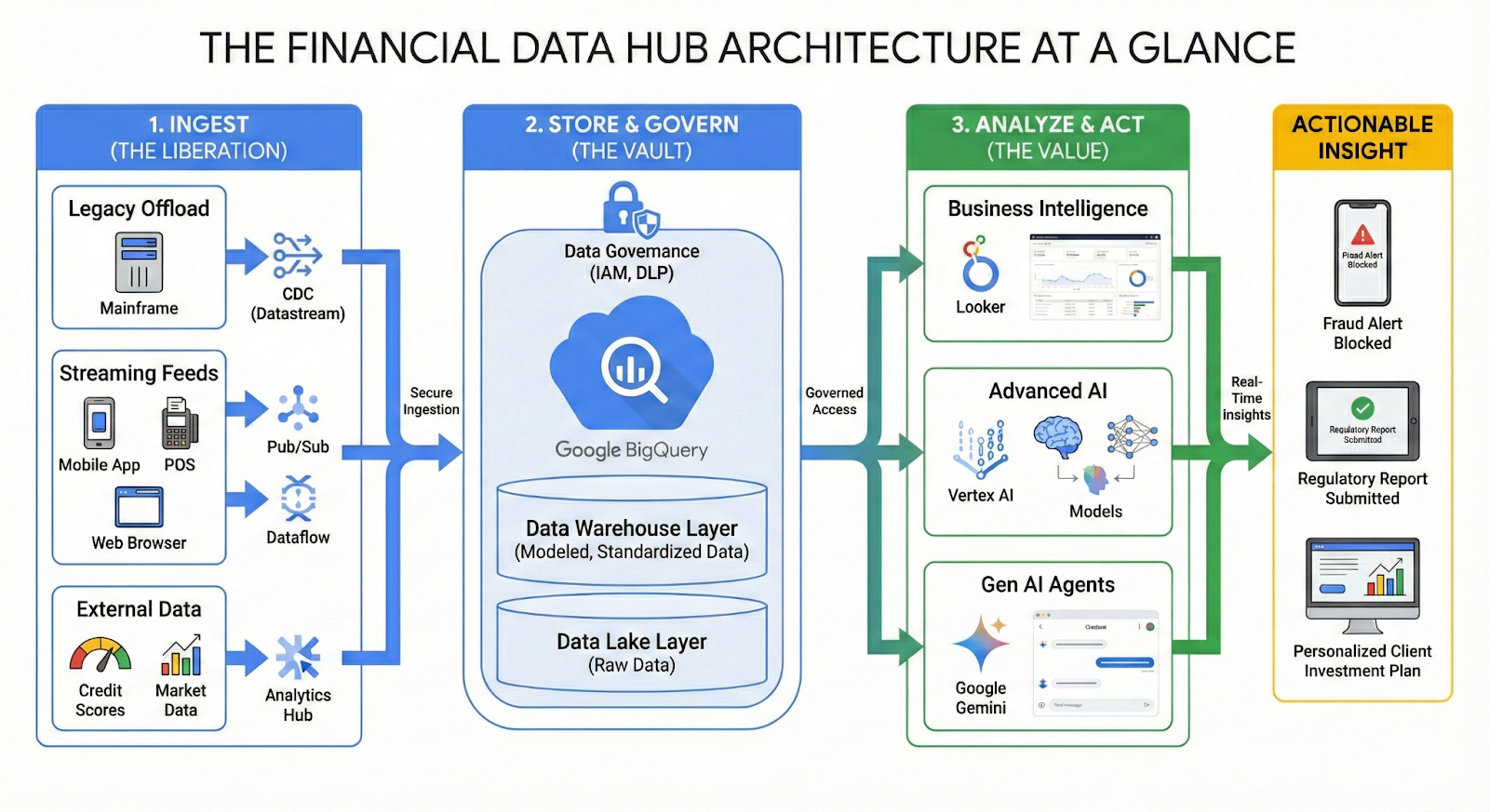
This architecture does not replace core banking or trading systems. Instead, it safely replicates and governs analytical copies of data, ensuring production systems remain isolated while downstream analytics gain speed and flexibility.
From Quick Wins to Data Strategy
Modernizing a financial institution's data estate is a marathon, not a sprint. Attempting a "big bang" migration is risky. We recommend a phased, value-driven approach:
Phase 1: The Targeted Win (Weeks 1-10). Select one acute pain point with high visibility, for example, optimizing one specific liquidity report that currently takes days to produce. We set up the BigQuery environment, ingest just that data, automate the pipeline, and prove the speed and cost benefits.
Phase 2: The Domain Migration (Months 3-9). Tackle a major data domain, such as "Customer Data" or "Mortgage Data." Establish strong governance, build the semantic layer, and begin decommissioning legacy reporting infrastructure related to that domain.
Phase 3: The Enterprise AI Foundation (Month 9+). With a solid data foundation in place, expand into advanced use cases: deploying generative AI for compliance document review, real-time personalization at scale, and democratized self-service analytics.
Why Evonence + Google Cloud for Financial Services?
In financial services, technology expertise is not enough. You need a partner who understands the nuances of compliance, security, and legacy complexity.
As a Premier Google Cloud Partner, Evonence sits at the intersection of financial acumen and cloud innovation.
Mainframe-to-Cloud Expertise: We understand the intricacies of offloading data from legacy cores without disrupting mission-critical operations.
Regulatory-First Architecture: We design data platforms with governance, lineage, and auditability built in from day one, not bolted on at the end.
From BI to Gen AI: We help you traverse the entire maturity curve, from stabilizing your basic reporting to deploying cutting-edge Gemini Enterprise solutions for risk and customer experience.
We don't just help you move data; we help you build a financial institution that moves at the speed of the modern market.
The Data-Driven Imperative
In the current financial landscape, the firms that win won't just be the ones with the biggest balance sheets; they will be the ones with the fastest, most accurate insights.
Clinging to fragmented, batch-oriented data processes in a real-time world is a risk strategy that is no longer tenable. Google BigQuery provides the secure, scalable foundation to turn your data liabilities into your greatest strategic asset.
Are you ready to stop reconciling the past and start predicting the future?
Next Steps: Assess Before You Commit
Take the first step toward a unified, real-time data strategy.
Legacy Data & Risk Assessment Workshop: Engage Evonence in a structured working session to evaluate how risk, finance, and customer data currently flow across your institution, where reconciliation and latency issues exist, and which BigQuery use cases offer the clearest regulatory and operational value.
BigQuery Financial Services Readiness Review: Our architects will review your current data landscape, including core systems, reporting platforms, and governance controlsand deliver a phased roadmap aligned to regulatory, security, and risk requirements.
Recommended Read: Gemini for Enterprise in Financial Services: The New Era of Intelligent Finance