Google BigQuery for Healthcare: The Power of Real-Time Patient Insights
The Urgent Need for Unified Healthcare Data
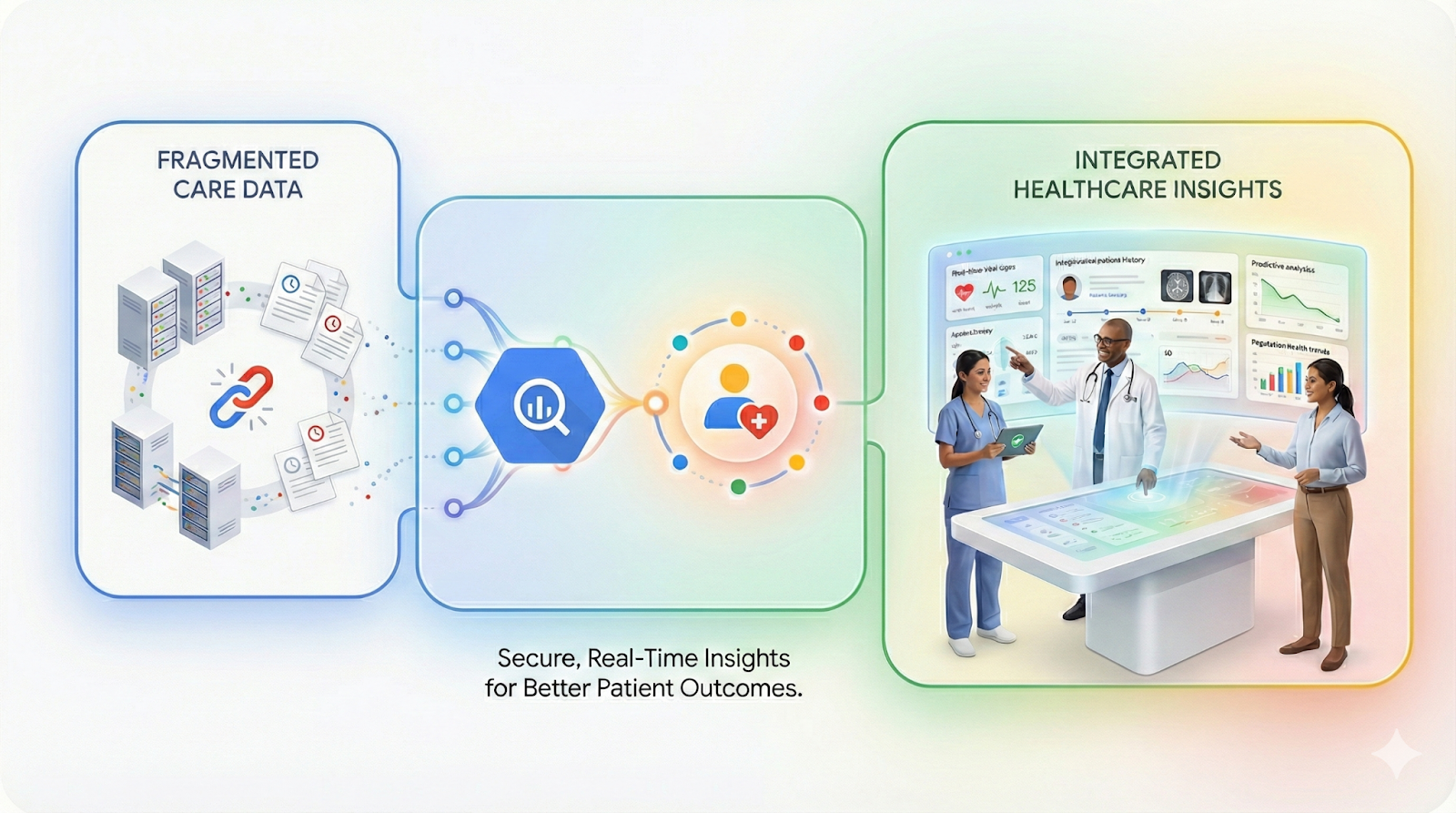
Modern healthcare delivery is facing a critical data crisis. While organizations possess vast amounts of patient and operational information, it remains locked in disconnected silos, from disparate EHRs and PACS to legacy administrative systems, creating dangerous blind spots at the point of care and significant administrative inefficiencies. Clinicians are often forced to make decisions based on incomplete snapshots, while staff burn countless hours manually reconciling data for reporting.
Overcoming this fragmentation requires a fundamental shift toward a unified, secure data foundation like Google BigQuery, designed to break down these walls and turn disconnected records into real-time, actionable intelligence.
This challenge reflects what Evonence consistently sees across hospital systems, integrated delivery networks (IDNs), and healthcare payers modernizing analytics for value-based care, operational efficiency, and regulatory reporting. The issue is not a lack of data, but the inability to securely unify clinical, operational, and administrative data in time to support care decisions.
The Unique Pathology of Healthcare Data
Healthcare data is uniquely difficult to manage. It is highly regulated, deeply personal, and incredibly messy. The current landscape is defined by several acute pain points.
The "EHR Fortress" Problem
EHR vendors designed their systems to capture billing and clinical documentation within their own walls, not to share it freely. While interoperability standards like FHIR are helping, extracting bulk data from legacy EHRs for large-scale analysis remains expensive and technically difficult. Your most valuable data is often held hostage by your primary vendor.
The Unstructured Deluge
Roughly 80% of valuable healthcare data doesn't live in neat rows and columns. It lives in free-text physician notes, pathology reports in PDF format, diagnostic images, and recorded telehealth sessions. Traditional analytics tools cannot see this data, meaning the rich context of a patient's condition is lost to automated analysis.
The Operational vs. Clinical Divide
In many hospital systems, the data governing operations (staffing schedules, bed capacity, supply chain) has zero connection to clinical data (acuity levels, discharge orders). This leads to ED bottlenecks where patients wait hours for a bed that might actually be clean, but the system hasn't updated yet.
Regulatory & Reporting Burnout
Compliance reporting (HEDIS, CMS quality measures, HIPAA audits) is a massive drain on resources. It often involves teams of nurses and administrators manually reconciling spreadsheets at the end of every quarter just to prove the quality of care that was delivered months ago.
Why Are Healthcare Leaders Rethinking Their Data Foundations?
As a Premier Google Cloud Partner, Evonence works with healthcare organizations navigating EHR interoperability, HIPAA compliance, and data-driven care delivery. The patterns below are drawn from real-world healthcare modernization initiatives involving EHRs, imaging systems, quality reporting, and AI-assisted clinical workflows.
What BigQuery Actually Changes?
For healthcare leadership, adopting Google BigQuery isn't just a tech refresh; it's a strategic capability upgrade centered on security and interoperability.
1. A HIPAA-Compliant Data Vault
First and foremost, security is non-negotiable.BigQuery operates within Google Cloud’s security framework, which supports HIPAA-aligned architectures when properly configured, including encryption, access controls, and audit logging. It offers encryption by default, both in transit and at rest, with granular identity controls that ensure only authorized personnel see sensitive Protected Health Information (PHI). These controls allow healthcare organizations to enforce least-privilege access, apply data loss prevention (DLP) policies to PHI, and maintain auditable access logs, capabilities required by compliance, privacy, and internal risk teams.
2. It Speaks the Language of Healthcare (FHIR)
You don't have to force healthcare data into a generic retail-style database model. Through the Google Cloud Healthcare API, BigQuery can natively ingest and understand healthcare-specific standards like HL7v2 and FHIR. This dramatically simplifies the process of harmonizing data from different EHRs.
3. Unlocking the Unstructured 80%
Because BigQuery is a "data lakehouse," it can store unstructured data alongside structured data. More importantly, it connects seamlessly to Google's AI tools (like Vertex AI and Gemini) that can read physician notes, extract key entities (like medications or diagnoses), and turn text into analyzable data.
4. The Foundation for Gen AI
Healthcare is emerging as a prime use case for generative AI, from summarizing lengthy patient histories to drafting appeal letters. BigQuery provides the clean, governed data foundation necessary to deploy these powerful AI models safely and effectively.
In clinical environments, generative AI is deployed with strict governance, human review, and clear usage boundaries. These tools support clinicians and administrators but do not replace clinical judgment, care protocols, or regulatory oversight.
Recommended Read: Gemini Enterprise for Healthcare: The Cure for Data Chaos?
Healthcare Use Cases: Saving Time, Money, and Lives
How does unifying data in BigQuery translate to better care and operations? Here are four concrete scenarios.
1. Real-Time Hospital Operations "Command Center"
The Situation: An urban hospital system struggles with ED overcrowding and slow inpatient bed turnover, leading to long wait times and ambulance diversions.
Data in Play: Real-time ADT (Admission, Discharge, Transfer) feeds from the EHR, bed management system status, environmental services (cleaning) logs, and nurse staffing schedules.
What BigQuery Enables: A real-time "air traffic control" dashboard (via Looker) displayed in the command center. It shows current ED capacity, predicts incoming surges based on historical trends, and flags beds that are clean but not yet marked as available.
The Impact: Reduced Length of Stay (LOS). The hospital can proactively open overflow units or expedite discharges before the ED gets overwhelmed, improving patient flow and safety.
2. The Longitudinal Patient Record (360-Degree View)
The Situation: A large Integrated Delivery Network (IDN) wants to improve care coordination for chronically ill patients who see multiple specialists across different facilities. Data in Play: Primary care EHR records, specialist notes (from different EHRs), claims data from payers, and patient-reported outcomes from a mobile app.
What BigQuery Enables: By ingesting and harmonizing these disparate sources using the Healthcare API, BigQuery creates a single, longitudinal view of the patient. A care coordinator can see the complete timeline of care, regardless of where it happened.
The Impact: Reduced duplicate testing and better care transitions. The care team has the full context, leading to better decision-making and a less frustrating experience for the patient.
3. Readmission Risk Prediction with AI
The Situation: Under value-based care models, a hospital is penalized for high 30-day readmission rates for conditions like heart failure.
Data in Play: Historical patient admissions, comorbidities, social determinants of health (SDOH) data (like zip code or housing status), and discharge summary notes.
What BigQuery Enables: Data scientists use BigQuery ML to build a predictive model. Every morning, the system scores patients scheduled for discharge based on their likelihood of readmission. High-risk patients are flagged for the discharge planning team.
The Impact: Proactive intervention. The hospital arranges home health visits or follow-up appointments for high-risk patients before they leave, reducing readmissions and avoiding penalties.
4. Automated Quality Reporting
The Situation: The quality department spends weeks every quarter manually compiling data for CMS reporting.
Data in Play: Clinical documentation, lab results, and administrative coding data scattered across various modules.
What BigQuery Enables: Instead of manual hunting, the necessary data points are automatically extracted, transformed, and loaded into BigQuery in near real-time. Dashboards track quality metrics continuously, not just quarterly.
The Impact: Massive administrative time savings. Clinicians spend less time on chart abstraction and more time on patient care.
Recommended Read: Transforming Healthcare: The Impact of Google Cloud's Innovations
High-Level Architecture: The Connected Care Hub
For Healthcare IT leaders, the goal is an architecture that embraces interoperability standards while ensuring rigorous security. BigQuery acts as the secure, central hub.
1. The Flow of Clinical Intelligence:
Ingest (The Translator): Clinical Data: The Cloud Healthcare API acts as the front door, accepting HL7v2 messages or FHIR resources from EHRs and harmonizing them.
Imaging: DICOM data from PACS systems is de-identified and moved into Cloud Storage, with metadata synced to BigQuery.
Streaming & IoT: Data from patient wearables or bedside monitors flows in via Pub/Sub.
2. Store & Govern (The Secure Lakehouse):
Harmonized clinical data lands in BigQuery.
Data is organized into patient-centric models.
Strict IAM (Identity and Access Management) policies and audit logging ensure HIPAA compliance.
3. Analyze & Act (The Point of Care):
Analytics: Operational dashboards and clinical metric tracking via Looker.
AI/ML: Vertex AI accesses the data for predictive modeling (e.g., sepsis detection risks).
Gen AI: Gemini models can be freely used to summarize patient charts or enable conversational search over medical guidelines.
The Architecture at a Glance: This architecture does not replace EHRs or clinical source systems. Instead, it securely harmonizes analytical copies of data, ensuring production systems remain isolated while enabling faster analytics, reporting, and AI-driven insights.
EHRs, PACS, IoT $\rightarrow$ Cloud Healthcare API (Harmonization) $\rightarrow$ BigQuery (HIPAA-Compliant Storage + ML) $\rightarrow$ Looker/Vertex AI/Gemini $\rightarrow$ Better Care Decisions
From Quick Wins to Data Strategy
Moving to a Data Cloud in healthcare requires a measured, compliance-first approach. We recommend a phased journey:
Phase 1: The Operational Quick Win (Weeks 1-12). Tackle a non-clinical, high-impact problem first to prove the model without heavy regulatory lifting. Example: A "Bed Capacity & Patient Flow" dashboard combining ADT feeds and staffing data.
Phase 2: Clinical Data Foundation (Months 3-9). Begin the harder work of clinical interoperability. Set up the Cloud Healthcare API to ingest a core set of FHIR resources (Patients, Encounters, Observations) from your primary EHR. Establish governance.
Phase 3: Advanced Intelligence (Month 9+). With a solid foundation, deploy AI. Use BigQuery ML for predictive risk scoring or pilot generative AI tools to assist physicians with documentation loads.
Why Evonence + Google Cloud for Healthcare?
In healthcare, "moving fast and breaking things" is not an option. You need a partner who understands that patient safety and regulatory compliance are paramount.
As a Premier Google Cloud Partner, Evonence combines cloud expertise with a deep understanding of the healthcare landscape.
Healthcare API Expertise: We know how to configure Google's specialized healthcare tools to navigate complex HL7 and FHIR integrations.
Security-First Mindset: We design architectures that are HIPAA-compliant by default, ensuring your data governance is audit-ready.
Bridging Clinical & IT: We help translate clinical needs into technical solutions, ensuring that data projects actually improve the workflow of doctors and nurses.
We don't just manage data; we help you build the infrastructure for the future of connected care.
Conclusion: Data as a Vital Sign
In modern medicine, data is as critical a vital sign as blood pressure or heart rate. When that data is fragmented, the picture of the patient is incomplete.
Clinging to siloed, legacy systems in an era of value-based care and consumer expectations is unsustainable. Google BigQuery provides the secure, scalable foundation to bring your data together, turning hindsight reporting into real-time foresight.
Are you ready to see the whole patient story?
Next Steps:
Take the first step toward a connected healthcare data strategy.
Healthcare Interoperability & Data Assessment: Engage Evonence in a structured working session to evaluate your current EHR integrations, data silos, and analytics workflows, and identify where BigQuery can deliver measurable operational and clinical value.
HIPAA-Aligned Data Cloud Readiness Review: Our architects will review your existing infrastructure, security controls, and interoperability maturity to deliver a phased roadmap aligned to healthcare compliance and patient safety requirements.
Recommended Read: Redefining Medical Diagnostics: Inside Evonence's AI-Powered Imaging Platform on Google Cloud
References
https://cloud.google.com/healthcare-api/docs/tutorials/fhir-bigquery-streaming-tutorial https://docs.cloud.google.com/healthcare-api/docs/how-tos/fhir-bigquery-streaming https://docs.cloud.google.com/healthcare-api/docs/how-tos/fhir-export-bigquery https://docs.cloud.google.com/healthcare-api/docs/introduction