Retail Cloud Migration: A Diagnostic Approach to Building Your Omnichannel Foundation
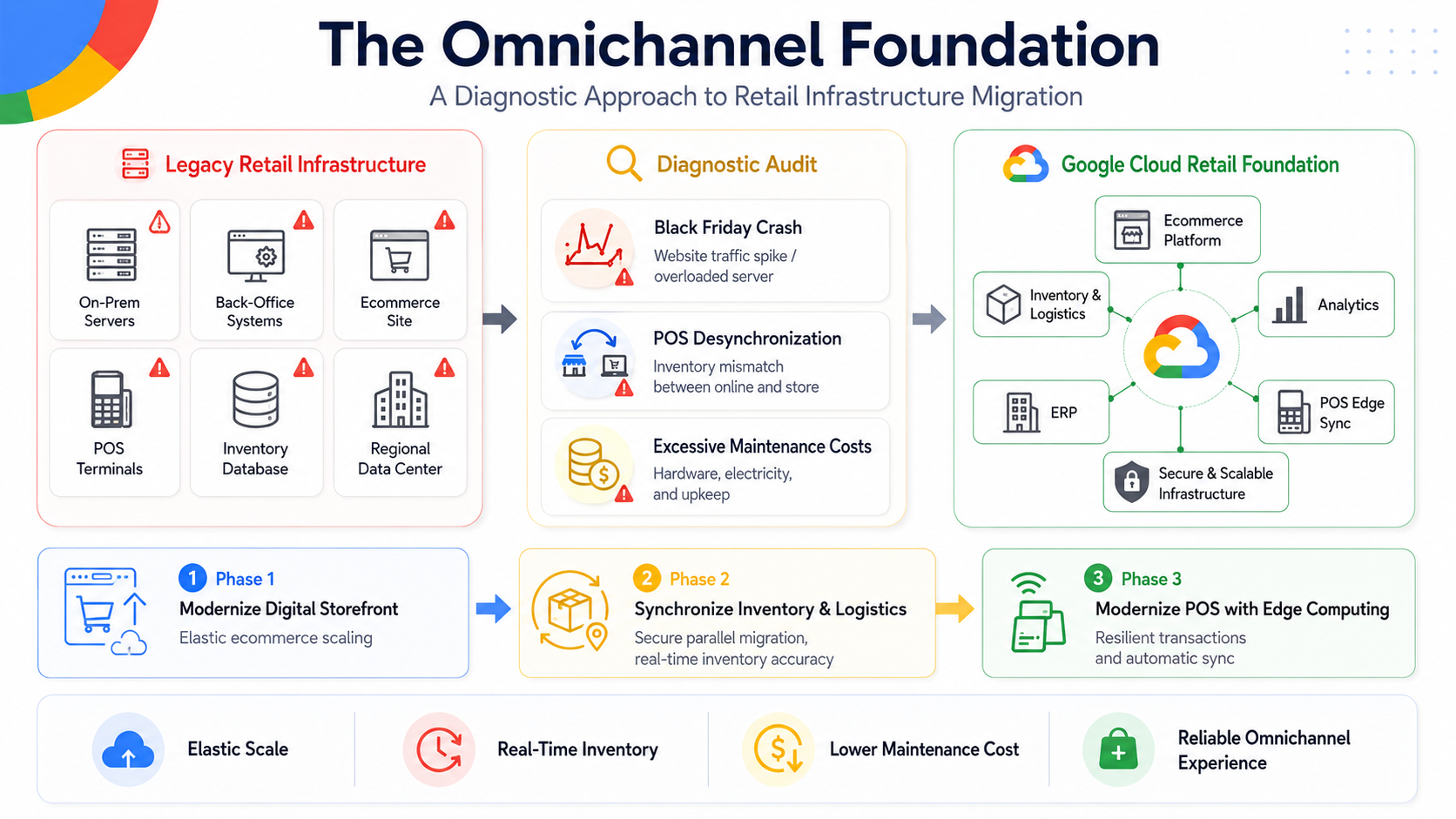
65.7% of shoppers now check a retailer's website for in-store product availability before they ever walk through the door, according to a 2026 Digital Commerce 360 survey. If that inventory data is wrong, slow, or out of sync, the sale is lost before the customer leaves their couch. For most retail brands, the culprit isn't strategy — it's the legacy server infrastructure still running the back office, and a Google Cloud retail infrastructure migration is now the fastest way to fix it.
Retailers keep investing in glossy apps and personalized storefronts while the systems underneath stay frozen in place. Physical, on-premises servers sitting in a back office or regional data center are expensive to cool, vulnerable to outages, and structurally incapable of absorbing the traffic spikes that define modern retail — a flash sale, a viral post, a holiday weekend. Every hour spent keeping that hardware alive is an hour not spent on the customer experience.
That's where a structured retail cloud migration changes the equation. As a Google Cloud Premier Partner with over a decade of enterprise migration experience, Evonence helps retail brands move their full stack — storefront, inventory, and point of sale — onto Google Cloud without disrupting a single day of sales.
Retail Infrastructure Audit: 3 Signs Your Legacy Systems Are Costing You Sales
Before recommending a single migration step, Evonence's architects run a diagnostic audit against your current environment. These three symptoms show up again and again in retail infrastructure that's actively losing revenue.
Sign #1: The Black Friday Crash
Your IT team spends weeks manually racking physical servers just to survive the holiday surge — and the site still slows to a crawl the moment traffic peaks. That's a sign your infrastructure has no elasticity left to give.
Google Cloud fix: Google Compute Engine and Cloud Run auto-scale on the same global network that powers Google Search, absorbing traffic spikes in seconds with no manual provisioning.
Sign #2: Point-of-Sale Desynchronization
A customer buys the last sweater online, but your in-store system doesn't reflect it for another fifteen minutes — resulting in a double-sold item and a frustrated shopper at the register. With 65.7% of shoppers checking inventory online before visiting a store, that lag is now a primary driver of lost foot traffic.
Google Cloud fix: Cloud Spanner gives you a single, globally consistent source of inventory truth, so online, app, and in-store systems read the same number at the same time.
Sign #3: Runaway Maintenance Costs
If the largest line item in your IT budget is replacing failing hardware and paying for server-room electricity, your capital is funding maintenance instead of innovation. That's capital your competitors are putting toward AI-driven personalization instead.
Google Cloud fix: Migrating to managed Google Cloud infrastructure shifts spend from fixed hardware costs to consumption-based pricing — capital that can be redirected toward growth.
Evonence's 3-Phase Retail Cloud Migration Strategy (Zero Downtime)
A retail environment can't tolerate a weekend outage to migrate its core systems. Evonence's phased approach to on-premises to cloud migration is built specifically to keep registers ringing and websites live throughout the transition.
Phase 1
Modernize the Digital Storefront
We migrate consumer-facing assets first — the ecommerce platform, product catalog, and checkout flow — onto Google Cloud Run and Cloud CDN, backed by Google's global load-balancing network.
When a viral social post drives 10,000 concurrent shoppers to your site in a single minute, the infrastructure scales automatically. You capture every sale instead of watching the site buckle.
Phase 2
Synchronize Core Inventory and Logistics
Your ERP and inventory databases move next, the most complex phase. We connect old and new systems through secure, encrypted pathways and run them in parallel on Cloud Spanner and BigQuery, validating every inventory query and logistics update side by side.
We only cut over once your global supply chain data is proven to synchronize in real time, with zero discrepancy between old and new systems.
Phase 3
Deploy Edge Computing at the Point of Sale
Finally, we modernize the physical stores using Google Distributed Cloud Edge, connecting registers directly to your cloud environment for real-time transaction and inventory sync.
If a store loses its primary internet connection, registers keep processing transactions locally and sync automatically the moment connectivity is restored — no downtime at the till.
Why Retail Leaders Choose Evonence for Google Cloud
Retail brands need a migration partner who understands both cloud architecture and the operational reality of a sales floor that never stops. Evonence has been a Google Cloud Premier Partner since 2014, with the technical depth and retail-specific experience to prove it.
Frequently Asked Questions
How long does a retail cloud migration typically take?
A full three-phase migration — storefront, inventory/ERP, and point-of-sale edge computing — typically runs 4 to 9 months depending on the size of your store footprint and the complexity of your existing ERP. Phase 1 alone (storefront) can often be completed in 4 to 6 weeks, delivering an early, visible win.
Can we migrate without taking our stores or website offline?
Yes. Evonence runs old and new systems in parallel during the most sensitive phases, particularly inventory and ERP synchronization, and only cuts over once data parity is proven. Your storefront and registers stay operational throughout.
What happens if a store loses internet connectivity after migration?
Edge computing, deployed via Google Distributed Cloud Edge, lets in-store registers continue processing transactions locally even without a live connection to the cloud. Transaction and inventory data sync automatically the moment connectivity returns.
Is a Google Cloud retail migration compliant with PCI DSS and GDPR?
Google Cloud's infrastructure is built to support PCI DSS and GDPR compliance, and Evonence's architects configure your environment — encryption, access controls, and data residency — to align with both standards as part of the migration, not as an afterthought.
Ready to Modernize Your Retail Infrastructure?
Schedule a free 30-minute Infrastructure Assessment with one of Evonence's Google Cloud-certified architects. We'll map your highest-ROI migration entry point — at no cost.